
Edgar-Haarschnitt
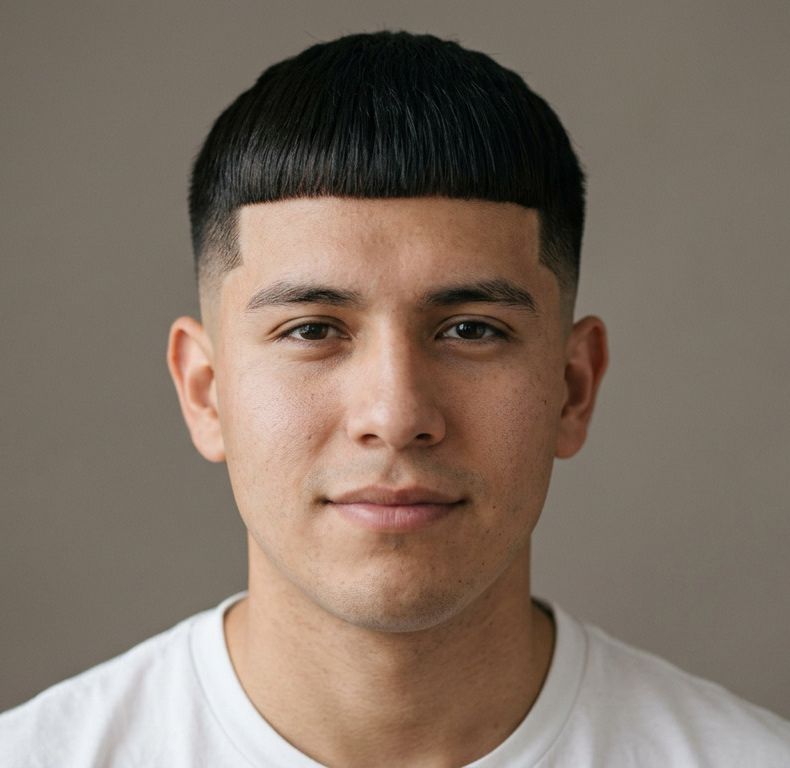
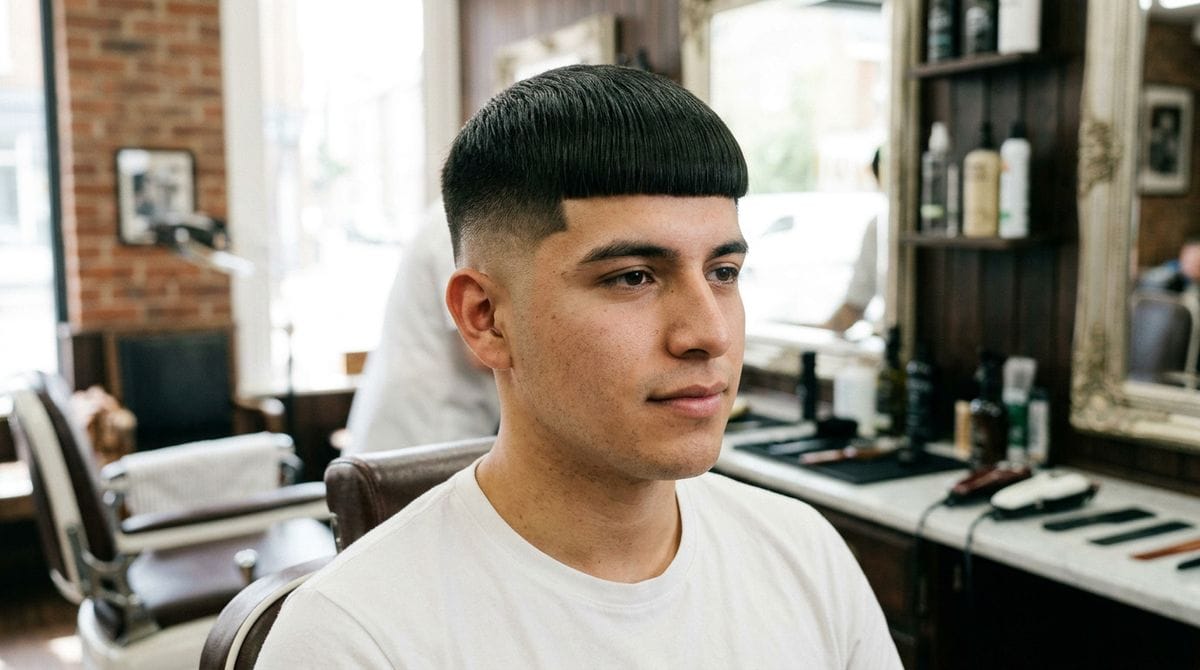
A straight, blunt fringe across the forehead, a sharp line-up and a high skin fade.
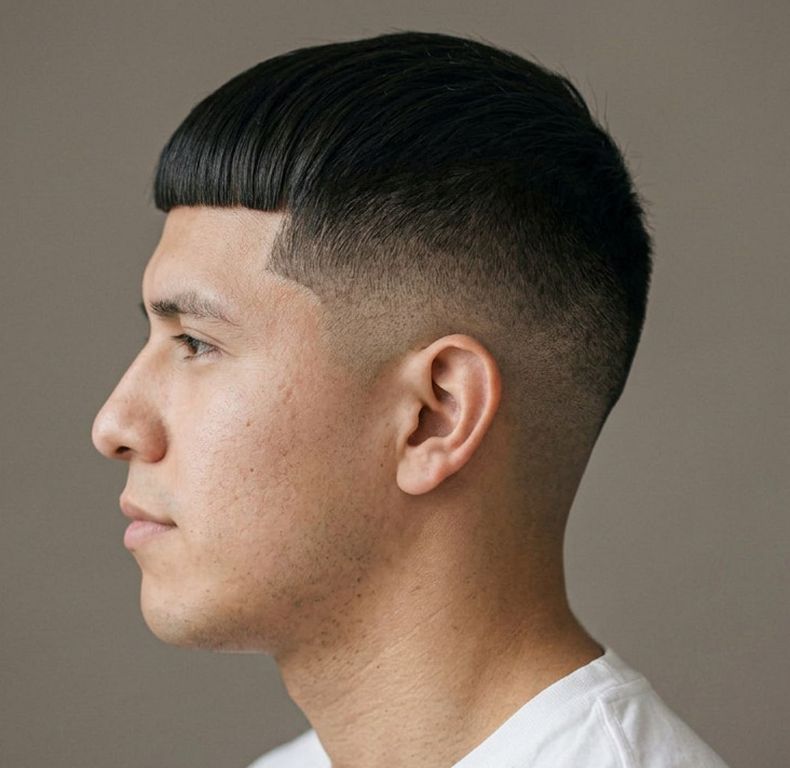
The Edgar haircut is a short cut with a dead straight, blunt fringe across the forehead, sharp squared-off corners at the temples, and sides taken short with a high skin fade or taper. The top is usually 3 to 5cm and brought forward to meet the fringe. It is the most hard-edged of the crop styles in the men's hairstyles directory, and it is all about clean lines.
Auf einen Blick
- Auch bekannt als
- Edgar cut
- Beilagen
- A high skin fade or burst fade
- Nach oben
- 3 to 5cm, often textured or curly
- Fringe
- Cut dead straight across the forehead
- Line-up
- Sharp square corners at the temples
- Instandhaltung
- Every 2 weeks
- Vermeiden Sie dies, wenn
- Your hairline recedes at the temples
5 £ Rabatt auf Ihre erste Lieferung
Ein frischer Haarschnitt kommt mit einem sauberen Nackenausschnitt am besten zur Geltung. Eine scharfe Klinge sorgt dafür, dass dies auch zwischen den Friseurbesuchen so bleibt – ganz ohne die Rasurbrandstellen, die eine stumpfe Klinge hinterlässt.
5 £ Rabatt auf Ihr erstes Abonnement oder Ihre erste VIP-Bestellung – einmal pro Kunde, Abmeldung mit einem Klick
So fragst du deinen Friseur
- Ask for an EdgarA straight blunt fringe and a line-up, with a high skin fade.
- Say where the fringe sitsUsually mid forehead.
- Ask for square cornersThe line-up at the temples is part of the shape.
- Choose the fadeHigh skin, burst or taper.
Die Varianten
Derselbe Schnitt, anders getragen. Was sich ändert, ist die Länge, wo der kurze Teil beginnt und wie das Oberteil gestylt wird.
Wird es bei deinem Haar funktionieren?
Der Haartyp bestimmt, wie ein Haarschnitt sitzt und wie schnell er seine Form verliert. Die folgende Tabelle gibt einen kurzen Überblick.
| Heterosexuell | Ideal | Holds a dead straight fringe. |
|---|---|---|
| Gewellt | Ideal | Waves add texture on top. |
| Lockig | Werke | The fringe line is harder to keep straight. |
| Coily | Werke | Short coily hair takes a sharp line well. |
| Dick | Ideal | Gives the blunt line weight. |
| Fein oder ausdünnend | Vermeiden | The line-up depends on a strong hairline. |
Passt es zu Ihrem Gesicht?
Ob ein Haarschnitt die Höhe betont oder die Breite reduziert, entscheidet darüber, wie er zu Ihrer Gesichtsform passt. Der Haartyp spielt zwar eine größere Rolle, aber das ist hier nur die Kurzfassung.
| Oval | Ideal | Ausgewogene Proportionen, sodass der Schnitt selbst den Ausschlag gibt. |
|---|---|---|
| Rund | Werke | Achte darauf, dass der Pony strukturiert bleibt; ein schwerer, glatter Pony lässt das Gesicht breiter wirken. |
| Platz | Werke | A softer, textured fringe takes the edge off a square jaw. |
| Länglich | Ideal | Ein Pony lässt das Gesicht schmaler wirken. |
| Herz | Ideal | Ein Pony lässt eine breite Stirn schmaler wirken. |
| Diamant | Ideal | Ein Pony lässt eine schmale Stirn breiter wirken. |
Passende Bartfrisuren
Haare und Bart bilden eine einheitliche Kontur. Diese sorgen bei diesem Schnitt für die richtigen Proportionen.

What an Edgar haircut is
Three features make it an Edgar rather than any other crop.
Die Fransen. Cut straight across in one horizontal line, usually somewhere around the middle of the forehead. Not curved, not choppy, not tapered at the corners.
The line-up. The barber edges the front hairline and the temples with a trimmer, so the fringe meets the sides at sharp, squared corners. This is what gives the Edgar its geometric look from the front.
Die Seiten. Usually a high skin fade or a high taper, so the sides drop away quickly below the fringe line. That contrast between a heavy, blunt top and bare sides is the whole silhouette.
The top itself can vary. On straight hair it is often kept fairly smooth and brushed forward. On wavy or curly hair it is left with more texture. The fringe line and the line-up stay the same either way.
Where the Edgar comes from
The Edgar is closely associated with Latino and Hispanic barbering in the United States, particularly among young Mexican-American men, and it has been a familiar cut in barbershops in Texas and across the American Southwest. It became widely known beyond those communities through social media, where barbers shared before and after videos of the cut.
Where the name came from is not well documented, and you will see several stories repeated online. What is clear is that it is a distinct style with its own barbering technique, and it has spread to barbershops in the UK and elsewhere. Most UK barbers who do a lot of fades and line-ups will know it by name.
Edgar vs French crop and textured crop
The Edgar is a crop, so it sits alongside the French crop and the textured crop. The difference is in the edges.
Edgar vs French crop. A French crop also has a short forward fringe, but the line is softer, the corners are rounded or blended, and the sides are often a gentler fade or taper. The Edgar is the same idea with every edge sharpened.
Edgar vs textured crop. A strukturierter Crop has a deliberately messy, broken fringe. The Edgar has a single straight line. They are almost opposites on top, even with similar sides.
Edgar vs Caesar. A Cäsar is shorter all over, with a short, straight fringe brushed forward and little contrast between top and sides. The Edgar keeps more length on top and pairs it with a much higher, sharper fade.
Who suits an Edgar haircut
Haartyp. Thick, straight or slightly wavy hair holds the blunt fringe best. Coarse and dense hair also takes the line-up very cleanly. Curly hair can wear an Edgar, but the fringe is harder to keep as a straight line, so curly versions tend to have more texture on top and a slightly softer front. Fine or thinning hair is a poor match, because the look depends on a strong, solid hairline for the line-up.
Hairline. This matters more than face shape. If your hairline recedes at the temples, the line-up has nothing to sit on, and a straight fringe across a receding front draws attention to it. A French crop or textured crop is kinder there.
Gesichtsform. Oval and square faces suit it best. A long face benefits from the fringe, which shortens the forehead. On a round face, a higher fade and a little more length on top keep it from looking wide.
Arbeit und Lebensstil. The classic Edgar is a bold cut. A school or conservative office may prefer a lower fade or taper with the same fringe. And it needs a barber regularly, so it suits men who are happy to be in the chair every couple of weeks.
How to ask a UK barber for an Edgar
Say "Edgar", and bring a photo, ideally of someone with a similar hair type to yours. Then confirm the details, because barbers who rarely cut one may hear it as a French crop.
Die Fransen. "Straight blunt fringe, cut across in one line, sitting about mid forehead."
The line-up. "Sharp line-up at the front, with square corners at the temples."
Die Seiten. Pick the fade.
- "High skin fade, sides to skin with a foil shaver at the bottom."
- "Burst fade round the ear, keep the back a bit longer."
- "High taper, no skin showing, for something more conservative."
Die Spitze. "About 4cm on top, brushed forward to the fringe."
A Hautverblassung is finished with a foil shaver or razor at the bottom. If you would rather not see bare skin, ask for a taper ending at a grade 0.5 or 1 instead. A burst fade curves the fade in an arc round the ear and leaves the neckline longer, which is a common Edgar variation.
Mention any cowlick at the front, since it can push the fringe off line, and say if you wear glasses.
Styling an Edgar
The cut does most of the work. Styling is mainly about getting the fringe to lie straight and flat.
Towel dry, then comb or brush everything forward from the crown so it falls onto the fringe. On straight hair, a quick blast with a hairdryer while brushing forward sets it in place. Use a small amount of matte paste or clay if you want hold, worked through from back to front, keeping the fringe line flat.
For a curlier or textured Edgar, use a little curl cream on damp hair and let it dry, then pat the fringe into line with your fingers.
Keep the finish matte. Shiny products clump the fringe and spoil the clean line.
Pflege und Schnittintervalle
The Edgar has the highest upkeep of the crop styles. Hair grows roughly 1cm a month, and the parts that give the Edgar its shape, the line-up and the high skin fade, are exactly the parts that blur first. Within a week or two the corners soften and the fade shadows over.
- Classic Edgar with a skin fade and line-up: every two weeks.
- Taper or lower fade: every three weeks or so.
Some men go in between full cuts for just a line-up and a fade refresh. Do not try to re-cut the fringe or the corners at home. It is very easy to push the hairline back, and that takes weeks to grow in.
Variationen und das Herauswachsenlassen
- Classic Edgar. Blunt fringe, sharp line-up, high skin fade.
- Taper Edgar. The same fringe and line-up with a high taper instead of skin. Grows out more gently and suits stricter dress codes.
- Burst fade Edgar. The fade curves round the ear, leaving more length at the back.
- Curly or textured Edgar. More texture on top and a slightly softer fringe line, while keeping the shape.
Growing out an Edgar is straightforward if you do it in stages. Ask the barber to soften the fringe corners and stop the line-up, let the fade drop lower, and let the top gain length. After a couple of visits it reads as a French crop, and from there it can go towards a textured crop or longer.
Fragen, die uns gestellt werden
What is an Edgar haircut?
A short haircut with a straight, blunt fringe cut across the forehead, a sharp line-up with square corners at the temples, and sides taken short with a high skin fade or taper. The top is brought forward to the fringe.
What is the difference between an Edgar and a French crop?
Both have a short forward fringe. The Edgar's fringe is dead straight and blunt, with sharp squared corners and usually a high skin fade. A French crop has a softer fringe, rounded corners and usually a gentler fade.
Can you get an Edgar with curly hair?
Yes. Curly Edgars usually keep more texture on top and a slightly softer fringe, since curls make a perfectly straight line hard to hold. The sides and line-up stay sharp. Ask for the fringe cut on dry hair so it does not spring up shorter than planned.
Does an Edgar haircut suit a receding hairline?
Usually not. The line-up and straight fringe need a solid hairline to sit on, and a straight line across a receding front tends to highlight it. A French crop or textured crop softens a receding hairline better.
Is the Edgar haircut acceptable for school or work?
It depends on the rules. The high skin fade and sharp line-up are what some schools and offices object to. A version with a taper instead of a skin fade and a slightly softer fringe is much more likely to pass. Check any dress code first.
How often does an Edgar need cutting?
About every two weeks for the classic version, because the line-up and skin fade blur quickly. A taper version can stretch to around three weeks.
Sonstige Kulturpflanzen
Nahe Verwandte und ihre Unterschiede.
Stöbern Sie nach dem, was Ihnen wichtig ist
Dasselbe Verzeichnis, aus einem anderen Blickwinkel betrachtet.