
Coupes de cheveux dégradées en effilé
A taper fade is the cut most men end up asking for when they want to look tidy without looking like they have just had a haircut. It keeps the shape of a traditional short back and sides and adds one clean, close edge at the bottom. Below is how it differs from a plain fade, the five versions worth knowing and how to ask for one.
The 3 heights of taper fade



Related fades
Not tapers, but the next step along if you want more contrast.


5 £ de réduction sur votre première livraison
Une coupe récente est particulièrement mise en valeur par une ligne de cou nette et des pattes soignées. Une lame bien affûtée permet de les garder ainsi entre deux rendez-vous, sans provoquer de rougeurs dues au rasage.
5 £ de réduction sur votre premier abonnement ou votre première commande VIP – une offre par client, désabonnement en un clic
What a taper fade actually is
A taper is the oldest move in the barber's book. The hair gets gradually shorter as it comes down the head, and the shortest of it sits right at the edges of the hairline, at the sideburns and the nape of the neck. The rest of the sides and back keep some length.
A fade does the same job across a much bigger area. The whole of the side and back is taken down short, usually close to skin at the bottom, and blended up into the longer hair over a band of several centimetres.
A taper fade borrows from both. The bottom goes down close, like a fade, but only at the hairline around the ears and at the neck. From the front it reads as a neat traditional cut. From behind, or up close, you see the sharp finish a fade gives.
Taper vs fade
The difference is how much of the head gets cut short. A taper only changes the length at the edges, so your natural hairline is still there, just shorter. A fade takes the whole side down and replaces the outline with skin or near enough.
A taper grows out gently, and three weeks later it still looks like a haircut. A fade looks sharpest in the first week and then shows every day of growth. If you want to understand the fade family on its own terms, the types of fade page goes through each one.
One practical warning. Plenty of barbers hear the word "fade" and take the sides down further than you meant. If you want only the edges done, say "taper" first and "fade" second.
If you want the graduation with no close-to-skin edge at all, ask for a plain taper haircut, cut with scissors or longer clipper grades so your natural hairline stays.
The types of taper fade
The name changes with where the taper starts. Everything else follows from that.
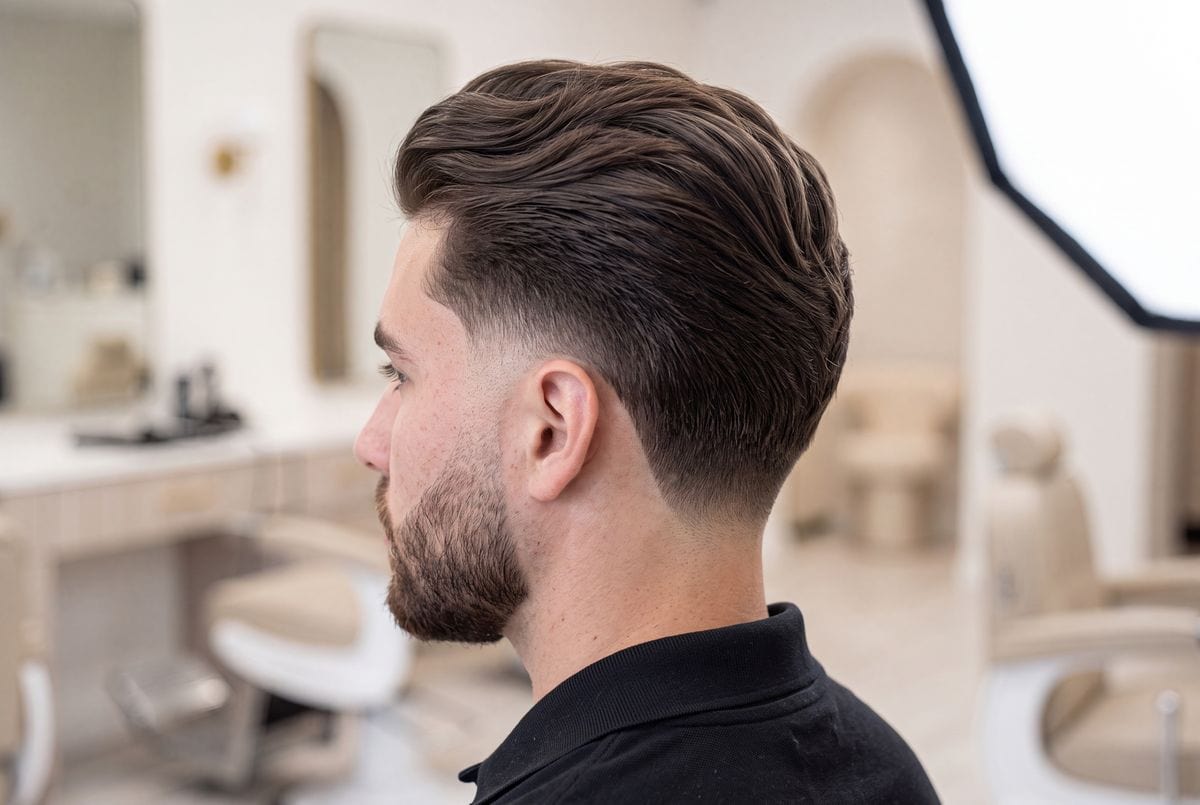
Faible conicité
Le low taper fade starts just above the ear and runs down to the neck. From the front you can barely see it. It is the safest choice for a first attempt, the easiest to grow out and the one that will pass without comment in any workplace.
Mid taper
Le mid taper fade starts higher, roughly level with the middle of the ear, and blends up towards the temple. The contrast is visible from the front without being loud. It suits most heads and most tops, and it is the one barbers tend to recommend when you cannot decide.
High taper
Le dégradé très prononcé starts up near the temples, well above the ear. It takes a lot of bulk out of the sides, which is why it suits thick and curly hair that would otherwise push outwards. It also shows the shape of your head more than any other version, so any bump or scar at the back will be on display.
Skin taper
A skin taper is any of the three above taken right down to bare skin at the bottom, with a foil shaver or an open blade instead of a grade 0. It gives the cleanest edge there is and the shortest life, because skin shows stubble within days. The dégradé de couleur page covers the full version.
Burst taper
The burst taper curves around the ear in a semicircle and leaves the back longer at the neck. It is most often worn with a curly top, a strip of length down the middle or a la coupe « mullet » moderne. Le fondu enchaîné page has the details.
The five side by side
| Type | Where it starts | Bottom of the sides | How often to cut | Idéal pour |
|---|---|---|---|---|
| Faible conicité | Just above the ear | Grade 0 or 1, blending to 2 or 3 | Toutes les 3 à 4 semaines | First-timers, offices, longer tops |
| Mid taper | Middle of the ear | Grade 0 or 1 | Toutes les 2 à 3 semaines | Most heads, crops and quiffs |
| High taper | Near the temple | Grade 0 or skin | Toutes les deux semaines | Thick or curly hair, short tops |
| Skin taper | Any height | Bare skin | Every 1 to 2 weeks | The sharpest finish, regular barber visits |
| Burst taper | An arc around the ear | Grade 0 or skin | Toutes les 2 à 3 semaines | Curly tops, mullets, a strip of length on top |
The cutting interval is the honest cost of each one. The higher and closer the taper, the faster it loses its edge.
Choosing a height
Start with your hairline. If you are receding at the temples, a high taper runs straight into the recession and draws a line to it. A low or mid taper leaves enough hair at the sides to keep attention off it, and the coupes de cheveux pour les hommes qui perdent leurs cheveux page goes further into that.
Then think about your hair. Fine straight hair shows every clipper line and needs a patient barber. Thick or coarse hair hides the blend but grows outwards, which is where the higher tapers earn their keep. The coiffures selon le type de cheveux page has more on matching a cut to what grows.
Last, be honest about how often you will go back. A low taper bought every four weeks looks better than a skin taper stretched to six.
What to wear on top
The taper only decides the sides. The top is a separate choice, and almost anything short to medium works with it.
A crop texturé ou un Récolte française over a mid taper is the common pairing and needs the least styling. A coiffure en crête ou un cheveux lissés en arrière wants a low taper, so the sides have enough length to sit under the volume. A high skin taper with a short straight fringe and a sharp line-up is an Edgar. For the rest of the options, the répertoire complet has every style we cover.
Comment s'adresser à son coiffeur
Barbers work from three decisions. Give them all three and you will get what you pictured.
Where it starts. Low, mid or high. If you are unsure, point to the spot on the side of your head.
How short it goes at the bottom. A grade 0, a half grade, skin, or a grade 1 if you want it softer. Ask for the neckline tapered into the neck, which grows out more gracefully, or squared off.
What happens on top. Say how much length to take off rather than how long to leave it, or ask for it "scissor over comb, just tidied". If you want texture, ask for it to be point cut.
Tell them if you want a line-up around the forehead and temples or the natural hairline left alone. And bring a photo of the back and side, because a front-on photo shows almost nothing of a taper.
Foire aux questions
What is the difference between a taper and a fade?
A taper only shortens the hair at the edges of the hairline, around the ears and at the neck. A fade takes the whole of the sides and back down short, usually close to skin at the bottom. A taper fade combines the two, with a close finish kept to the edges.
Which taper fade should I get first?
A low taper. It is the least noticeable, the easiest to grow out and the easiest to take higher next time if you want more contrast. Going lower after a high taper means waiting for it to grow.
How often does a taper fade need cutting?
Every three to four weeks for a low taper, every two to three for a mid, and every one to two if it goes down to skin. The closer and higher the taper, the sooner it looks grown out.
What grade is a taper fade?
There is no single number. Most tapers go down to a grade 0 or a half grade at the bottom and blend up through a grade 1 and 2 into the length on top. Ask for skin if you want it taken right down.
Is a taper fade professional enough for work?
A low or mid taper is about as conservative as a modern haircut gets and will go unremarked almost anywhere. A high skin taper or a burst taper is more of a statement, so judge it against your workplace.
Does a taper fade work on curly hair?
Very well. A taper keeps the sides tight while the curls stay on top, and a high or burst taper stops curly hair from growing out wide over the ears. Find a barber who regularly cuts curly or afro hair, because the blend is harder to get even.
Autres moyens d'affiner la recherche
Types de coupes « fade »
L'endroit où commence le dégradé, jusqu'où il s'étend, et les formes intermédiaires.
3 stylesLongueurs de coupe « buzz cut » et réglages de tondeuse
Du niveau 1 au niveau 4, ainsi que les raccourcis qui en découlent.
5 modèlesCoiffures pour hommes aux cheveux mi-longs et longs
Coupes qui nécessitent de la longueur sur le dessus, à l'avant ou à l'arrière.
7 stylesCoiffures pour hommes selon le type de cheveux
Which cuts suit straight, wavy, curly, coily, thick and fine hair.
11 modèlesCoupes de cheveux classiques pour hommes
Des classiques du barbershop qui ont survécu à toutes les modes.
6 modèlesCoupes de cheveux pour les cheveux clairsemés et en perte de densité
Des coupes courtes qui donnent l'impression que la perte de cheveux est voulue.