
Raie sur le côté
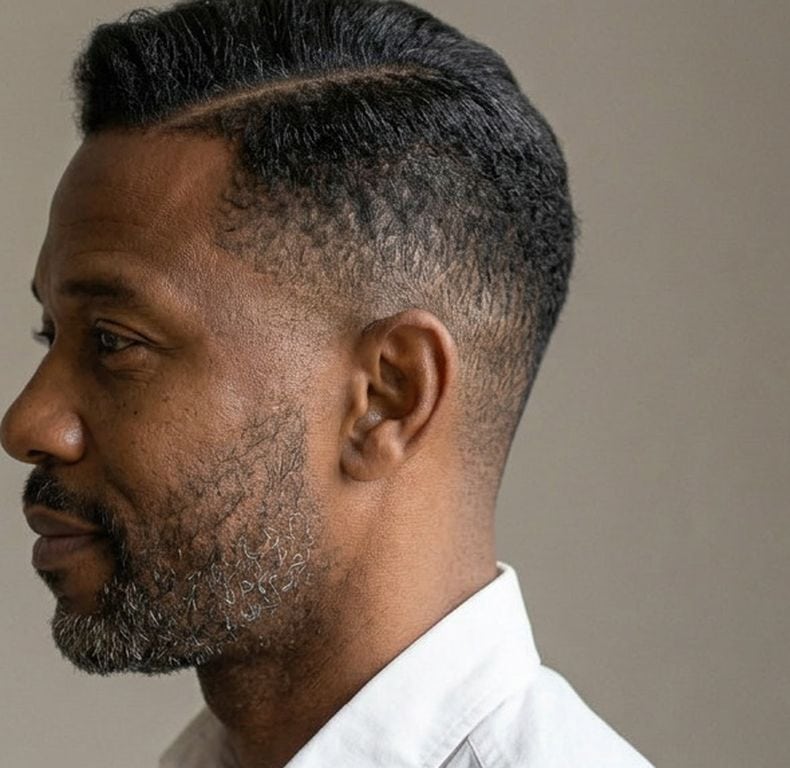
Hair combed to one side from a clear parting, over neatly tapered sides.
A side part is a men's hairstyle where the hair on top is divided by a parting on one side of the head and combed across, with shorter, tapered back and sides. The parting usually sits above the outer corner of one eye, and the top is left about 4 to 7cm long so it lies flat when combed. It is the smart default of men's hair, and of every cut in the directory it is probably the one most often worn without anyone asking for it by name.

En bref
- Également appelé
- Side parting
- Accompagnements
- Tapered, a grade 2 to 3 or scissor cut
- Haut de la page
- 4 to 7cm, long enough to comb over
- Parting
- Above the outer corner of one eye, natural or shaved in
- Entretien
- Toutes les 3 à 4 semaines
- À ne pas manquer sur
- Most faces. A smart default for work
- À éviter si
- Your hair has a strong crown whorl that fights the parting
- Rendu populaire par
- Jon Hamm (as Don Draper in Mad Men), David Tennant (subtly swept back)
5 £ de réduction sur votre première livraison
Une coupe récente est particulièrement mise en valeur par un cou bien rasé. Une lame bien affûtée permet de conserver ce résultat entre deux rendez-vous, sans provoquer les irritations que laisse une lame émoussée.
5 £ de réduction sur votre premier abonnement ou votre première commande VIP – une offre par client, désabonnement en un clic
Comment s'adresser à son coiffeur
- Find your partingAsk where your hair parts naturally. That is usually the best place for it.
- Choisissez les campsTapered with scissors, a grade 2 to 3, or a fade.
- Natural or hard partSay whether you want the parting shaved in.
- Say how you wear itCombed flat and neat, or looser with texture.
Les variations
La même coupe, portée différemment. Ce qui change, c'est la longueur, l'endroit où commence la partie courte et la façon dont le haut est coiffé.
Est-ce que ça ira avec vos cheveux ?
Le type de cheveux détermine la façon dont une coupe tient et la rapidité avec laquelle elle perd sa forme. Le tableau ci-dessous en présente un résumé.
| Hétéro | Idéal | Holds a clean parting. |
|---|---|---|
| Ondulé | Idéal | Waves give the sweep some body. |
| Bouclé | Œuvres | Leave enough length for the curls to fall to one side. |
| Coily | Œuvres | Best as a short top with a hard part. |
| Épais | Idéal | Thin the top so it lies across. |
| Cheveux fins ou clairsemés | Œuvres | A soft parting is kinder than a hard one on thin hair. |
Est-ce que ça ira bien avec votre visage ?
C'est la façon dont la coupe ajoute de la hauteur ou enlève de la largeur qui détermine comment elle s'harmonise avec la forme de votre visage. Le type de cheveux a certes plus d'importance, mais voilà en bref.
| Ovale | Idéal | Des proportions équilibrées : c'est la coupe elle-même qui fait la différence. |
|---|---|---|
| Rond | Œuvres | Add a little lift at the front so it does not sit flat and wide. |
| Carré | Idéal | A neat parting suits a defined jaw. |
| Oblong | Œuvres | Keep the top fairly flat rather than lifted. |
| Cœur | Idéal | A side parting breaks up a broad forehead. |
| Diamant | Œuvres | A parting with some fullness on top works. |
Les styles de barbe qui vont bien avec
Les cheveux et la barbe ne forment qu'un seul et même contour. C'est ce qui permet de respecter les proportions de cette coupe.



What a side part is
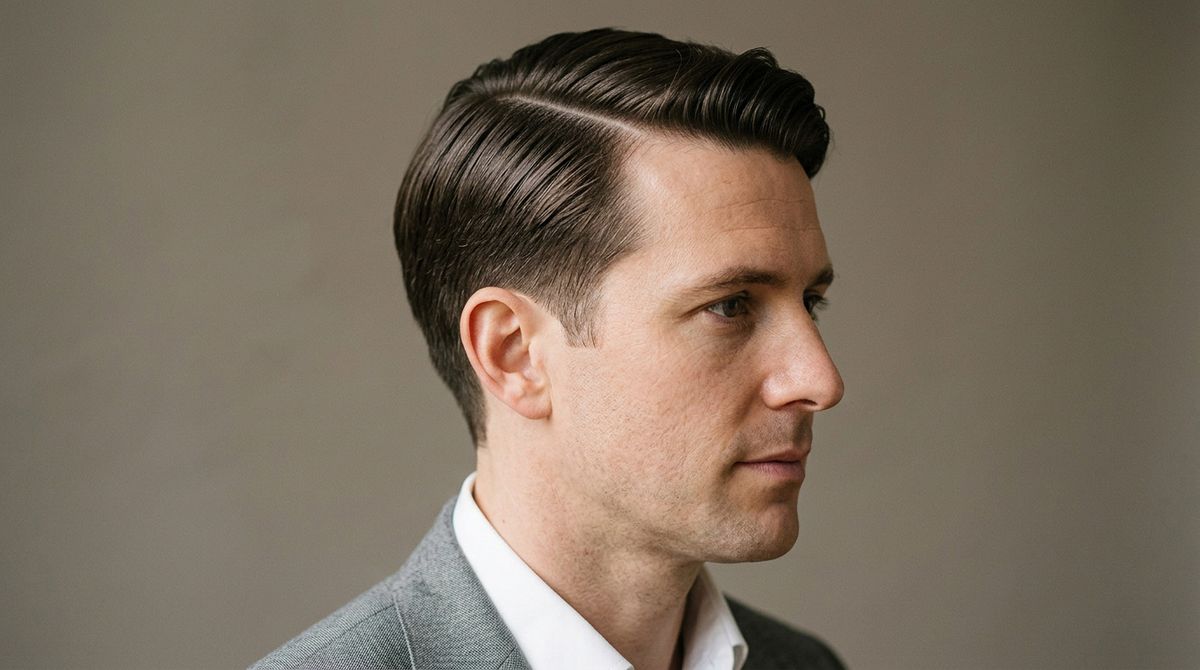
Most classic cuts can be worn with a side parting, so the side part is less a single haircut than a way of wearing one. What makes it a style of its own is the combination. Short, neat sides, usually a grade 2 or 3 (6mm or 9mm) or scissor cut, tapered at the neck. A top long enough to comb over without springing back. And a clear parting line, with the larger section of hair combed across and slightly back.

The finish is up to you. Combed and slightly shiny looks formal. Pushed into place with the fingers and a matte product looks relaxed. Both are the same cut.
The side parting has been the standard smart men's haircut for a very long time, which is why it looks at home in an office, at a wedding or in a school photo.
Finding your natural parting
Almost everyone has a side the hair wants to part on. Working with it makes the style sit better and take less effort. Fighting it means a cowlick that pops up by lunchtime.
To find yours:
- Wet your hair and towel dry it until it is damp.
- Comb it straight back off the forehead.
- Push the whole top forward with the palm of your hand.
- Look where it splits. That is your natural parting.
If nothing obvious happens, look at the whorl at your crown. The hair usually parts more easily on the side the whorl turns towards. As a starting point, line the parting up with the outer corner of one eye, or the highest point of the eyebrow.
If you are still unsure, wear it on each side for a few days. The side that needs less product and stays put longer is the right one.
Natural parting vs hard part
A natural parting is made with a comb each morning. It is softer, grows out without anyone noticing and lets you change sides or styles later.
A hard part is a thin line shaved into the scalp along the parting, usually with clippers or a trimmer. It gives a sharp, graphic edge and does the job of the comb for you. The catch is upkeep. Within a week or two the line softens as the hair grows back, so it needs redoing at most cuts. It also exposes scalp, which is unkind if the hair along the parting is thin.

A hard part pairs naturally with faded sides. A natural parting suits a classic taper. If you want a hard part with a long top and a fade, you are getting close to a comb over.
Who a side part suits
Cheveux raides is the easiest. It lies flat, shows a clean line and holds the shape with very little product.
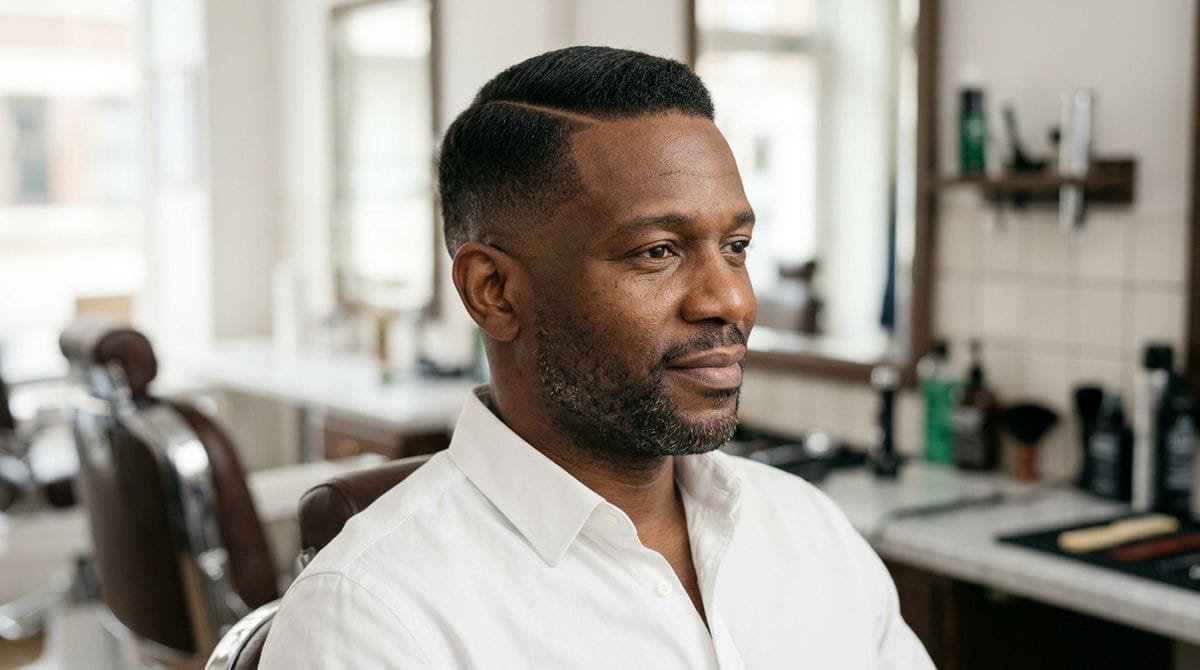
Cheveux ondulés gives a softer side part with natural movement. Use a cream rather than a heavy pomade so the wave stays.
Cheveux épais holds a parting well but can puff out above the ears. Ask the barber to take weight out and keep the sides tight.
Cheveux bouclés can carry a side part, but the line will be softer. A shallow hard part helps it show through the curl. Separate along it with your fingers rather than a fine comb.
Cheveux fins ou clairsemés is fine with a side part, as long as it is a natural one. Combing the hair across rather than straight back hides more scalp. Avoid a hard part directly over a thin area, and see coupes de cheveux pour les hommes qui perdent leurs cheveux if thinning is more than slight.
Forme du visage matters less here than with most cuts. A side parting adds a little asymmetry and height, which suits round and square faces well, and it is unlikely to look wrong on anyone. The coiffures selon le type de cheveux page has more on matching cut to hair.
How to ask a UK barber for a side part
Barbers cut this every day, so be specific about the parts that vary.
- Les côtés. "Grade 2 on the sides, tapered at the neck" is the classic version. Ask for a grade 3 (9mm) or scissor over comb if you want it softer. For more contrast, ask for a low fade or a low taper fade instead, starting from a grade 0.5 or 1 around the ears.
- The top. Say how much to take off, or ask them to "leave enough to comb over, about 5cm". Below about 4cm the parting will not show and the hair sticks up.
- The parting. Tell them which side. Ask them to find your natural one if you do not know. Say whether you want it shaved in.
- La fin. Ask for the top to be cut so it lies flat, rather than heavily texturised, if you want a smooth, combed look.
If you want a slightly shorter, more structured version with the top graded from front to crown, ask for an Ivy League instead. It is a close cousin and has its own page.
Styling a side part at home
A minute or two most mornings.
- Start with damp hair. Towel dried, not dripping.
- Add a little product. A pea-sized amount of cream for a natural finish, pomade for shine, or clay for matte texture. Rub it between your palms and work it in from the roots.
- Set the parting. Run the end of a comb from the front hairline back along your parting line, then comb the hair either side of it away from the line.
- Comb the top across. Sweep the larger side across and slightly back. Comb the smaller side down and back.
- Dry it in place. Optional. A hair dryer on low heat, aimed in the direction the hair is combed, holds the shape for longer. Lift the roots on the larger side with your fingers if you want a little height.
On dry hair, a comb and a small dab of product will reset it in the afternoon.
Upkeep and how often to cut
Every three to four weeks for a classic side part with tapered sides. Every two to three weeks if you have a fade or a hard part, because both lose their edge quickly.
At each cut the barber should tidy the sides and neckline, keep the top long enough to comb, and redo the hard part if you have one. Long sides are the most common problem. When they grow out the cut looks bulky and the parting gets lost.
Combing along the same line every day trains the hair to fall that way. Changing sides now and then is fine, but expect a day or two of the hair fighting back.
Variations
- Classic side part. Natural parting, grade 2 or 3 or scissor sides. The office standard.
- Hard part. The parting shaved in. Sharper and more modern, with more upkeep.
- Faded side part. Faded sides for more contrast. Needs cutting more often.
- Textured side part. Matte product, looser finish, styled with the fingers. Less formal.
- Deep side part. The parting set lower, so more hair sweeps across. Closer to a comb over.
Grow the top longer and the side part can turn into a comb over, a side-swept cheveux courts derrière et sur les côtés or, combed straight back, a slick back.
Questions qui nous sont fréquemment posées
Which side should I part my hair on?
The side your hair naturally splits on. Comb damp hair back, push it forward and see where it parts. If there is no clear answer, wear it on each side for a few days and keep the one that stays in place with less effort.
How long does hair need to be for a side part?
About 4 to 7cm on top. Below about 4cm the hair is too short to lie across and the parting disappears. The sides can be as short as you like.
What is a hard part?
A thin line shaved into the scalp along the parting with clippers or a trimmer. It makes the parting sharp and permanent until it grows back, which takes a week or two, so it needs redoing at most cuts.
Is a side part good for a receding hairline?
Usually, yes. Combing the hair across rather than back covers more of the temples and breaks up the line of the forehead. Keep the parting natural rather than shaved in, especially if it falls near a receding corner.
Can I have a side part with curly hair?
Yes, though the line will be softer than on straight hair. Keep enough length on top for the curls to fall to one side, and ask for a shallow hard part if you want the parting to show clearly.
How often should I get a side part cut?
Every three to four weeks with tapered sides. Every two to three weeks if the sides are faded or the parting is shaved in.
Other classic cuts
Des proches parents, et en quoi ils diffèrent.
Parcourez les contenus en fonction de ce qui vous intéresse
Le même répertoire, vu sous un autre angle.