
Corporate beard
the short full beard that goes unremarked anywhere
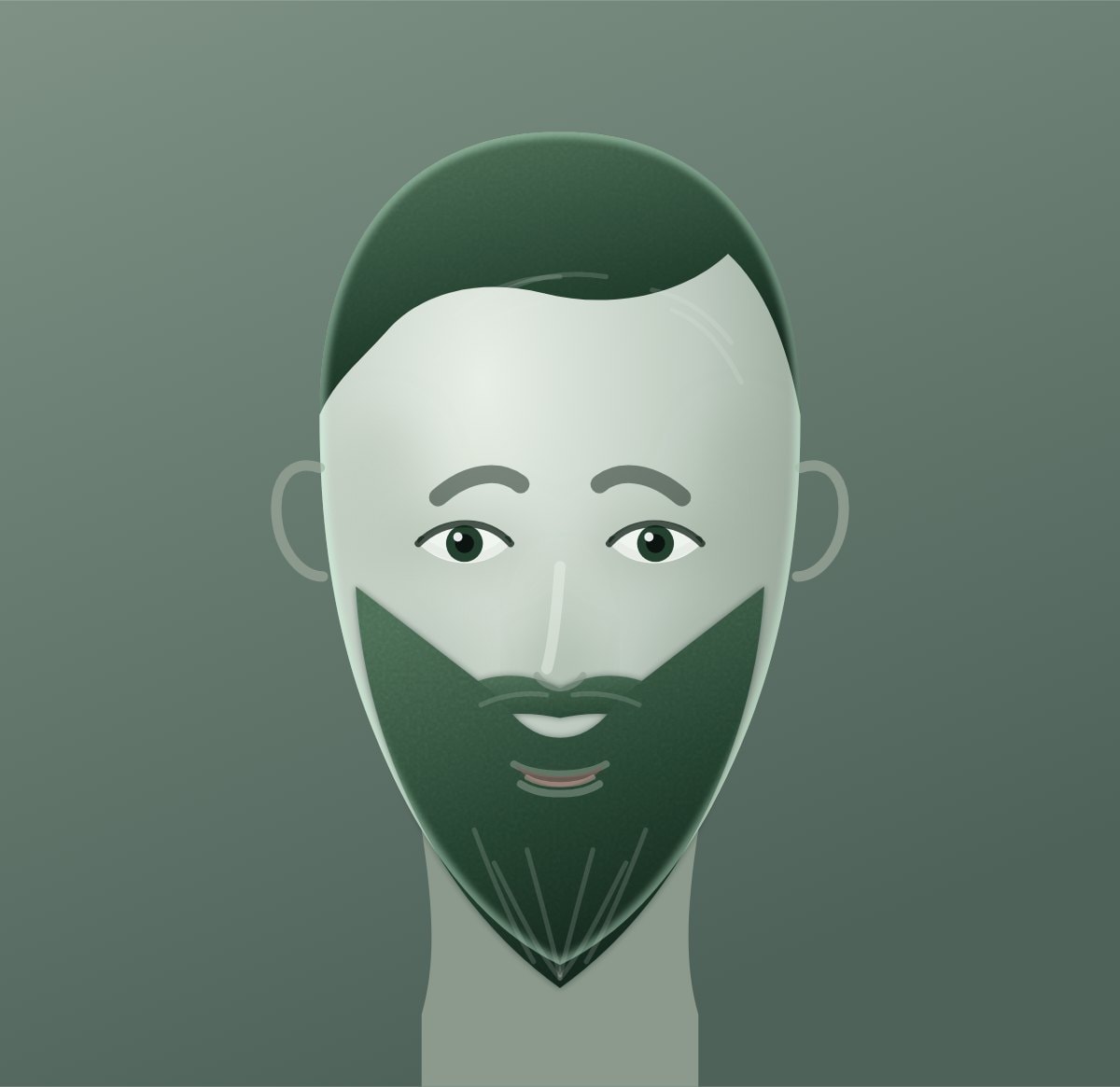
The corporate beard is a short full beard kept at one even length with tidy edges and nothing decorative about it. No carved cheek line, no fade, no point. It is the beard you wear when you want facial hair and you do not want anyone to comment on it. It is the least remarkable entry in the directory, and that is the entire brief.
It is also, for most men most of the time, the correct answer.

At a glance
- Also known as
- Nothing else in common use
- What it is
- A short full beard, edges tidy, nothing showy.
- Length
- Short, under an inch
- Growing time
- 3 to 4 weeks
- Trim how often
- Every 1 to 2 days
- Best face shapes
- Any
- Moustache
- Yes
£5 off your first delivery
Tidy is the entire point of a corporate beard, and tidy comes from the edges. Cheeks and neck, every other morning.
£5 off your first subscription or VIP order - one per customer, unsubscribe with 1 click
The variations
The same shape, worn differently. What changes is length, density and how much you take off at the edges.
Will it suit your face?
Where a style puts weight, and where it takes it away, is what decides whether it suits you. The table below is the short version.
| Oval | Ideal | Takes almost any length and shape without fighting the proportions. |
|---|---|---|
| Round | Avoid | Adds width where there is already width. A chin-led style suits better. |
| Square | Works | Round the corners off or it doubles up on a jaw that is already strong. |
| Long | Ideal | Width at the cheeks shortens the face. Keep the chin short, not pointed. |
| Heart | Works | Weight low balances a wide forehead, so long as the cheeks stay tidy. |
| Diamond | Ideal | Fills the narrow jaw and squares off the lower face. |
How to cut one, in four steps
- Grow it out3 to 4 weeks. Cutting into a beard that has not filled in leaves holes you then have to grow out again.
- Set the lengthStart on a longer guard than you think you need and work down. You cannot put it back.
- Set the necklineTwo fingers above the Adam's apple, curving up to behind the jaw. Higher than that and you lose the jawline.
- Tidy the cheeksFollow your natural cheek line rather than inventing a straight one. Take off anything above it.
Full detail, tools and the common mistakes are in the guide below.
What makes a beard a corporate beard
Cheeks, jaw, chin and moustache all connected, all at the same length, somewhere between six and twenty millimetres. The edges are tidied rather than sculpted: you clean the neckline properly, take strays off above the cheek line, and stop there.
The difference between this and a boxed beard is entirely in the edges. A boxed beard has a deliberate straight cheek line and squared corners. A corporate beard follows your natural growth line and rounds off. It is the less sharp of the two and the less work.
The difference between this and a full beard is length and discipline. A full beard is allowed to get long and take its own shape. A corporate beard is held at a set length indefinitely.
Who it is for
Anyone who wants the practical benefits of a beard without making a statement with it. It suits every face shape, which almost nothing else on this site does, because at this length it follows the face rather than reshaping it.
It is the safest option in a conservative workplace. Finance, law, client-facing work, interviews: a well-kept corporate beard reads as grooming rather than as a choice, and that is exactly the point.
It also suits men who are new to beards. There is no shape to get wrong and no technique to learn beyond a neckline, so it is a reasonable first beard that can be grown out later into something more deliberate once you know what your growth actually does.
What it needs is even coverage. This is the one demand it makes. At ten millimetres a thin patch on the cheek is visible, because there is not enough length for surrounding hair to fall across it. If your cheeks come in sparse, the patchy beard styles page has better options, and a chin-led style will look far more deliberate than a corporate beard fought for and lost.
Growing it
Three to four weeks gets you enough to work with. Six weeks gives you a comfortable margin.
Leave it entirely alone for the first two weeks, including the neck if you can get away with it. The hair at the jawline and under the chin comes through slowest, and shaping before it arrives sets your lines too high.
At two weeks, do the neckline and nothing else.
At three or four weeks, take the whole beard down to one length with a guard and see what you have. That single pass is what turns three weeks of not shaving into a beard.
Setting the length
Six to ten millimetres is short, neat and reads as very deliberate. It needs re-cutting weekly to stay that way.
Ten to fifteen millimetres is the standard corporate beard. Enough presence to be a beard, short enough to be invisible in any setting.
Fifteen to twenty millimetres is the top end before it stops being this style and becomes a full beard.
Go against the grain for an even cut. Going with the grain leaves it longer than the guard number suggests, which is fine as long as you are consistent, and confusing if you are not.
Keeping it
Reset the length weekly. One guard, whole beard, two minutes. This is the entire maintenance routine and skipping it for a fortnight is what turns a corporate beard into an untidy one.
Neckline every three or four days. Two finger-widths above the Adam's apple, curved to follow the jaw round to just below each ear. Never on the jawbone.
Cheeks whenever strays appear. Just the obvious ones above your natural line. Resist the urge to cut a straight edge, because that is a different style and a bigger commitment.
Trim it dry, combed out. Wet hair sits longer than its real length and springs back shorter.
Under about fifteen millimetres it does not need oil. Moisturiser on the skin underneath does more, particularly in the first few weeks when the itch is skin rather than hair.
Where it goes wrong
Letting the length drift. The failure mode of this style is not a bad decision, it is no decision. Two weeks without a reset and it is simply a beard that is getting away from you.
Cutting a cheek line by accident. Tidying strays a little lower each week ends with a carved line you did not choose.
Neglecting the neck. The single thing that separates tidy from unkempt at this length.
Growing it with patchy cheeks. It will not fill in, and short beards expose gaps rather than hiding them.
Questions we get asked
What is a corporate beard?
A short full beard held at one even length, usually six to twenty millimetres, with a clean neckline and natural cheek lines. Tidy rather than styled.
Is a beard acceptable at work?
A well-kept corporate beard is unremarkable in almost every workplace now, including conservative ones. Length is rarely the issue. A clean neckline and even length are what make it read as deliberate.
How long does it take to grow?
Three to four weeks to have enough to shape, six for a comfortable margin.
What is the difference between a corporate beard and a boxed beard?
The edges. A boxed beard has a deliberate straight cheek line and squared corners. A corporate beard follows your natural line and rounds off, so it is softer and less work.
How often should I trim it?
Reset the length weekly and do the neckline every three or four days. That is the whole routine.
Do I need beard oil?
Under about fifteen millimetres, not really. Moisturiser on the skin underneath is more useful.
Will it suit my face?
Almost certainly. It is one of very few styles that suits every face shape, because at this length it follows the face rather than trying to change it.
Other full beards
Same shape, different length or moustache.
If this one is too much work
Same idea, less of your morning.
Browse by what matters to you
The same directory, cut a different way.