
La coupe César
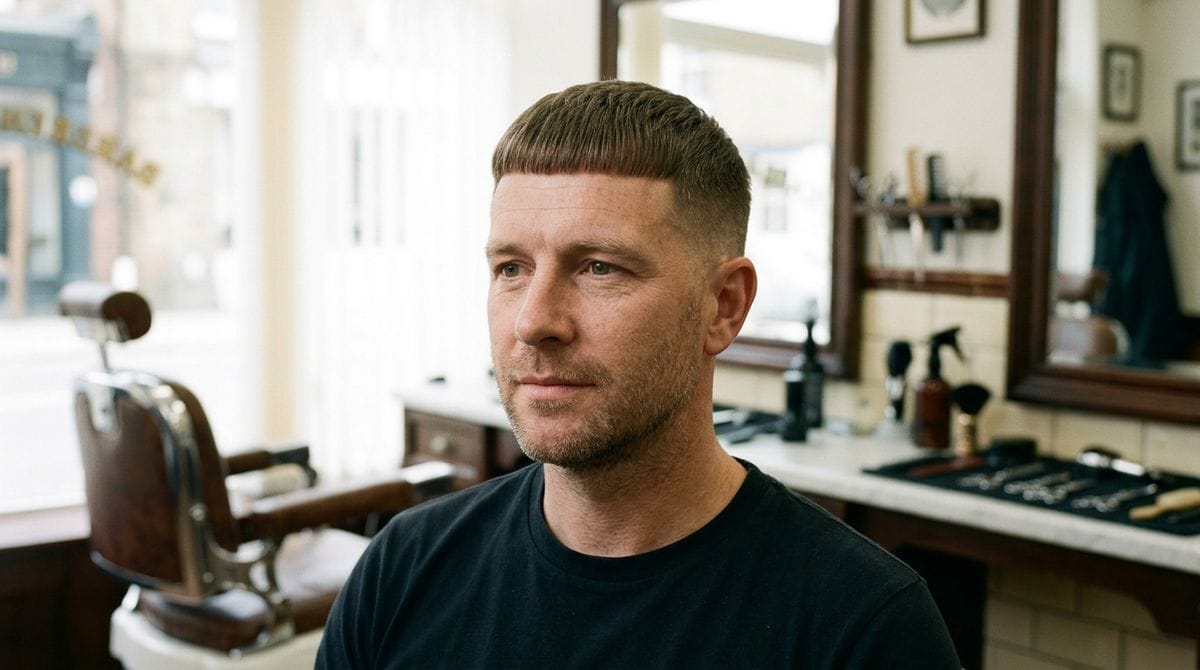
Short and even all over the top, brushed forward into a short, straight fringe.
A Caesar haircut is a short men's cut where the top is kept at a fairly even length, around 1 to 3cm, and brushed forward from the crown to a short, straight fringe, over short back and sides. There is no parting and little height. It is one of the plainest cuts among the full hairstyles directory, and one of the most useful if your hairline has started to go.


En bref
- Également appelé
- Caesar cut
- Accompagnements
- A grade 1 to 3, or faded
- Haut de la page
- 1 to 3cm, the same length all over
- Fringe
- Short and straight, cut horizontally across
- Entretien
- Toutes les 3 à 4 semaines
- À ne pas manquer sur
- Oval and square faces, and receding hairlines
- À éviter si
- You want any volume on top
- Rendu populaire par
- George Clooney (as Dr Doug Ross in ER in the mid 1990s), Benedict Cumberbatch (a soft, tapered version), Joseph Quinn (with a textured fringe)
5 £ de réduction sur votre première livraison
Une coupe récente est particulièrement mise en valeur par un cou bien rasé. Une lame bien affûtée permet de conserver ce résultat entre deux rendez-vous, sans provoquer les irritations que laisse une lame émoussée.
5 £ de réduction sur votre premier abonnement ou votre première commande VIP – une offre par client, désabonnement en un clic
Comment s'adresser à son coiffeur
- Ask for a CaesarShort and even on top, brushed forward into a short straight fringe.
- Give the top lengthUsually 1 to 3cm.
- Choisissez les campsA grade 1 to 3, or a fade.
- Say no line-upUnless you want it sharper, which takes it towards an Edgar.
Les variations
La même coupe, portée différemment. Ce qui change, c'est la longueur, l'endroit où commence la partie courte et la façon dont le haut est coiffé.
Est-ce que ça ira avec vos cheveux ?
Le type de cheveux détermine la façon dont une coupe tient et la rapidité avec laquelle elle perd sa forme. Le tableau ci-dessous en présente un résumé.
| Hétéro | Idéal | Lies forward easily. |
|---|---|---|
| Ondulé | Œuvres | Keep it short so waves do not lift the fringe. |
| Bouclé | Œuvres | Very short only. |
| Coily | Idéal | A short even top with a straight front works well. |
| Épais | Idéal | Thick hair gives the fringe body. |
| Cheveux fins ou clairsemés | Idéal | The forward fringe covers a receding hairline. |
Est-ce que ça ira bien avec votre visage ?
C'est la façon dont la coupe ajoute de la hauteur ou enlève de la largeur qui détermine comment elle s'harmonise avec la forme de votre visage. Le type de cheveux a certes plus d'importance, mais voilà en bref.
| Ovale | Idéal | Des proportions équilibrées : c'est la coupe elle-même qui fait la différence. |
|---|---|---|
| Rond | Œuvres | Veillez à ce que la frange ait du volume ; une frange lisse et épaisse élargit le visage. |
| Carré | Idéal | A short, even top with a straight fringe suits a strong jaw. |
| Oblong | Idéal | Une frange raccourcit le visage. |
| Cœur | Idéal | Une frange permet d'affiner un front large. |
| Diamant | Idéal | Une frange élargit un front étroit. |
Les styles de barbe qui vont bien avec
Les cheveux et la barbe ne forment qu'un seul et même contour. C'est ce qui permet de respecter les proportions de cette coupe.



What a Caesar haircut is
Three things make it a Caesar.

The direction. Everything on top goes forward. Not up, not back, not to the side.
The even top. The hair is roughly the same length from the crown to the front, rather than graded longer at the front like a crew cut. That gives it a flat, compact shape that sits close to the head.
The fringe. Short, usually 1 to 2cm, sitting well above the eyebrows and cut in a straight horizontal line. Straight, but not usually razor-sharp.
The back and sides are short, typically a grade 1 to 3 (3 to 9mm), and blended into the top. A classic Caesar keeps the blend soft. A modern one fades the sides down further.
The name is generally linked to Julius Caesar and the short, forward-combed hair seen on Roman portraits, though the details of that story are more legend than record.
Caesar vs French crop, Edgar and crew cut
Caesar vs French crop. The closest relative. A Récolte française is usually a little longer on top, more textured, and often has more contrast between a longer top and faded sides. A Caesar is shorter and more even all over. Grow a Caesar's top out a couple of centimetres and texture it, and you have a French crop.
Caesar vs Edgar. Le Edgar haircut takes the forward fringe and makes it dead straight and blunt, adds a sharp line-up with square corners at the temples, and pairs it with a high skin fade. A Caesar is softer at every edge and has much less contrast.
Caesar vs crew cut. A coupe en brosse is about the same length but graded, longest at the front, with the front pushed up or to the side. A Caesar goes forward and is even.
Caesar vs buzz cut. A buzz cut is clippers all over with no fringe to speak of. A Caesar has a defined fringe, cut with scissors, and that line is what makes it a style. The buzz cut lengths page covers the shorter end.
Who a Caesar suits
Receding and thinning hair. This is the Caesar's best trick. Bringing all the hair forward to a short fringe covers early recession at the temples and makes an M-shaped hairline read straighter. Keeping the top short and even stops fine hair separating and showing the scalp, which longer styles do. Keep the fringe short and dense. Dragged long from too far back, it separates and draws the eye to exactly what you are hiding. If the recession is advanced, the coupes de cheveux pour les hommes qui perdent leurs cheveux page covers what comes next.
Type de cheveux. Straight hair gives the cleanest fringe line. Wavy hair works well with the fringe left a fraction longer so the wave does not lift it. Thick hair needs thinning on top, or it sits like a helmet. Curly and coily hair suits a short Caesar very well, with the fringe following the curl rather than forced straight.
Forme du visage. The fringe shortens the forehead, so it helps a long face or a high forehead. Oval and square faces suit it easily. On a round face, tighter sides help.
When to avoid it. A low forehead can look crowded under a fringe. And a strong cowlick at the front can make the fringe split or lift, though a barber can usually work round one with a slightly textured line.
Work and lifestyle. It is tidy enough for any office, takes a minute in the morning, and survives hats, helmets and sport.
How to ask a UK barber for a Caesar haircut
"Caesar" is a name most UK barbers know, but say what you want for each part so you do not walk out with a French crop or a buzz cut.
For a classic Caesar:
"Caesar cut please. Grade 2 back and sides, blended. About 2cm on top, even all over, brushed forward to a short straight fringe about a finger above my eyebrows. Not too blunt."
For a modern faded Caesar:
"Caesar with a low skin fade, starting just above the ears. About 2 to 3cm on top, all forward, short textured fringe."
The points to agree:
- Les côtés. A grade 1 to 3 blended for a classic version. A low or mid fade for more contrast. Skin fades are finished with a foil shaver at the bottom; say if you do not want bare skin.
- The top length. Give it in centimetres. Some barbers will clipper the top at a grade 4 to 6 (12 to 19mm) and then scissor the fringe.
- The fringe. Where it should sit on your forehead, and whether you want it straight and clean or slightly broken up.
- Your hairline. If you are covering recession, say so. The barber will leave a little more weight at the front corners.
Ask the barber to check the fringe line with you in the mirror before they finish. A fringe cut too high is the one Caesar mistake that takes weeks to fix.
Styling a Caesar
This takes almost no time.
- Towel dry.
- Brush or comb everything forward from the crown, so it falls to the fringe.
- If you want hold or texture, rub a small amount of matte clay or paste between your palms and work it through from back to front. Finish by pressing the fringe into line with your fingertips.
On hair that wants to go sideways, a quick blast with a hairdryer while brushing forward sets the direction. Wavy hair takes a little light cream or salt spray on damp hair, left to dry. Curly hair needs only a little curl cream.
Keep the finish matte, especially on thinning hair. Shiny products clump fine hair and show the scalp.
Upkeep and how often to cut
Hair grows roughly 1cm a month, which on a 2cm top is half the haircut. The fringe gets heavy first, then the sides puff out over the ears.
- Classic Caesar, blended sides: every three to four weeks.
- Caesar with a skin or high fade: every two to three weeks.
Between visits, tidy the neckline with a trimmer if you like, but leave the fringe alone. Home fringe trims are how Caesars end up crooked.
Variantes et laisser pousser ses cheveux
- Classic Caesar. Grade 2 blended sides, about 2cm even on top, straight fringe.
- Caesar fade. The same top over a low, mid or high fade. The types of fade page explains each.
- Textured Caesar. The top point cut and the fringe broken up. Softer and better on fine hair.
- Short Caesar. Grade 3 or 4 clippered on top with just the fringe scissor cut. Close to a buzz cut.
- Long Caesar. 3 to 4cm on top with a heavier fringe. Heading towards a French crop.
- Curly Caesar. Short natural curl on top, brushed forward, over a taper or low fade.
A Caesar grows out without drama. Keep the sides trimmed and let the top go. In a month or two it becomes a French crop or a textured crop, and from there you can push the front up, part it, or keep growing.
Questions qui nous sont fréquemment posées
What is a Caesar haircut?
A short men's haircut with the top cut to a fairly even length and brushed forward to a short, straight fringe, over short back and sides. There is no parting and little height.
What is a Caesar fade?
A Caesar with the sides faded rather than simply cut short. The top and fringe stay the same, and the sides drop down to a very short grade or skin from a low, mid or high starting point. It has more contrast than a classic Caesar and needs cutting every two to three weeks.
Is a Caesar haircut good for a receding hairline?
Yes, it is one of the best. The forward fringe covers recession at the temples, and the short, even top stops thin hair separating. Keep the fringe short and dense rather than long.
What is the difference between a Caesar and a crew cut?
A crew cut is graded, longest at the front and shorter at the crown, with the front pushed up or to the side. A Caesar is roughly even on top and brushed forward to a straight fringe.
What do I ask the barber for a Caesar cut?
Say "Caesar cut", then give the side grade (usually a 1 to 3, or the fade you want), the top length in centimetres, and where you want the fringe to sit. Mention a receding hairline or a cowlick if you have one.
How often does a Caesar need cutting?
Every three to four weeks for a classic Caesar with blended sides. With a skin fade, every two to three weeks.
Autres cultures
Des proches parents, et en quoi ils diffèrent.
Parcourez les contenus en fonction de ce qui vous intéresse
Le même répertoire, vu sous un autre angle.