
BATNA: Best Alternative to a Negotiated Agreement

BATNA Explained in 30 Seconds
BATNA stands for “Best Alternative to a Negotiated Agreement” – essentially, it’s your best fallback option if this negotiation fails. The term comes from the 1981 book Getting to Yes by Roger Fisher and William Ury from the Harvard Law School Negotiation Project, and it’s become the foundation of modern negotiation strategy.
Key Takeaways
- BATNA, or Best Alternative to a Negotiated Agreement, is your strongest fallback option if negotiations fail, providing a clear safety net.
- A well-defined BATNA gives you negotiation power by allowing you to negotiate confidently and avoid accepting unfavourable deals.
- Understanding both your own BATNA and the other party’s BATNA offers valuable insights into negotiation dynamics and helps you make informed decisions.
- The reservation value, or walkaway point, is the worst deal you are willing to accept before choosing your BATNA instead.
- Identifying the Zone of Possible Agreement (ZOPA) helps determine if a successful deal is achievable by finding the overlap between both parties’ acceptable terms.
- Developing and continuously updating your BATNA before and during negotiations ensures you stay grounded and prepared for changing circumstances.
- Avoid common pitfalls such as overestimating your BATNA, ignoring implementation costs, or falling victim to emotional decision-making.
- Strategically deciding when to reveal your BATNA can strengthen your position or protect you from weakening it, depending on its strength.
- Mastering BATNA is essential for negotiating effectively, securing better outcomes, and maintaining control at the bargaining table.
Quick Links
Imagine you’re a software engineer in 2025 evaluating a job offer for £120,000. Your BATNA isn’t just “finding another job” – it’s the specific, confirmed alternative you already have: a written offer from Company B for £115,000 with better benefits and remote work options.

Here’s why mastering your BATNA can make all the difference in your next negotiation:
- Better deals: Knowing your alternatives prevents you from accepting unfavourable terms
- Confidence to walk away: A strong BATNA eliminates desperation and pressure tactics
- Reduced stress: Clear alternatives transform negotiations from emotional gambles into strategic decisions
- Fewer costly mistakes: Your BATNA acts as a safety net against poor judgment under pressure
What Is BATNA in Negotiations?
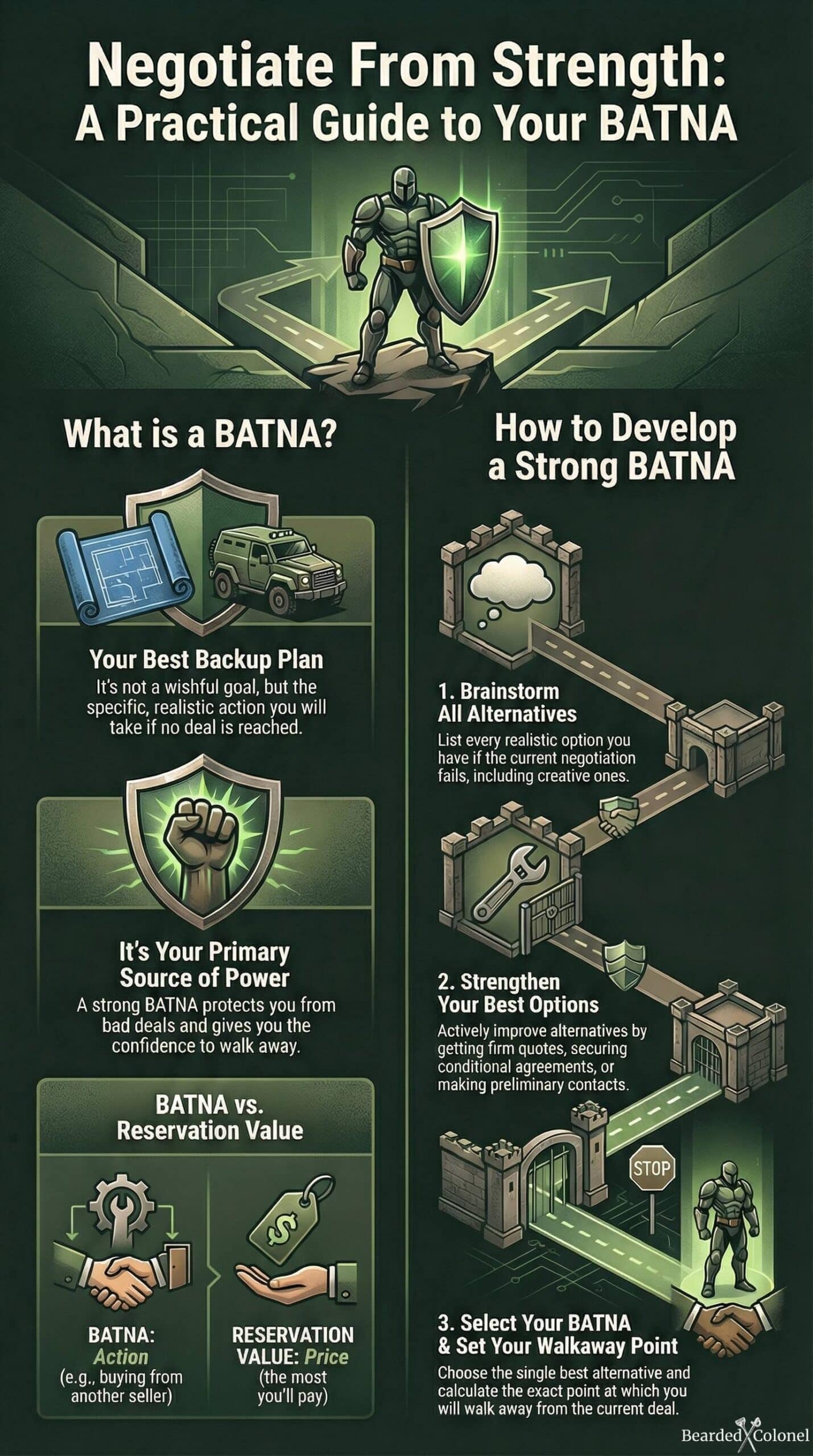
BATNA stands for “Best Alternative to a Negotiated Agreement” and serves as your backup plan when the current deal falls through. It’s not a wishful target or asking price – it’s the specific, realistic action you will take if negotiations fail.
Your BATNA must be concrete and actionable. For example, if you’re negotiating a supplier contract in early 2026, your BATNA isn’t “finding another vendor someday.” It’s the signed letter of intent you have with Supplier B to deliver the same materials for a 5% price increase starting Q2 2026.
The concept functions both as a mental framework for how you think about alternatives and as a practical tool for what you’ll actually do next week or next month. This dual nature makes BATNA different from simply “having options” – you must identify, analyse, and actively choose the best of all possible alternatives.
Consider Sarah, a freelance consultant negotiating a six-month contract in 2024. Her potential BATNAs include:
- Accepting a confirmed three-month project with a previous client
- Taking on two smaller projects she’s already been offered
- Extending her current contract with existing terms
- Using savings to invest time in building her online course business
Her BATNA isn’t all of these options – it’s whichever single alternative provides the best outcome if the current negotiation process breaks down.
The Importance of a Strong BATNA
Your BATNA is your primary source of negotiating power because it determines how desperately you need any specific deal. When you have attractive alternatives, you negotiate from strength. When your alternatives are weak or nonexistent, every other party at the bargaining table senses your vulnerability.
A well-defined BATNA delivers multiple strategic advantages:
- Protection from unfavourable deals: You’ll never accept terms worse than your best alternative
- Enhanced confidence: Knowing you have solid backup options reduces anxiety and improves performance
- Resistance to pressure tactics: Urgency and deadline manipulation lose their power when you have genuine alternatives
- Clear decision-making: You can evaluate offers objectively against your baseline rather than emotionally
Consider Marcus, a sales director who entered 2023 salary negotiations with his current employer. His BATNA was a written offer from a competitor for £95,000 plus equity – a 15% increase over his current compensation. When his employer initially offered only a 3% raise, Marcus confidently declined and referenced market rates. The final negotiated agreement included a £92,000 base salary, additional vacation time, and a promotion timeline that beat his outside alternative option.
Without that confirmed backup plan, Marcus likely would have accepted the initial 3% offer out of uncertainty about other opportunities. His solid BATNA transformed the conversation from “please give me more” to “here’s what it takes to keep me.”
The danger lies in misjudging your BATNA strength. Negotiators frequently overestimate their alternatives (thinking they can “easily find something better”) or underestimate them (accepting poor terms because they assume no other party would want them). Both mistakes lead to suboptimal negotiation outcomes and lost value.
BATNA vs. Reservation Value (Walkaway Point)
BATNA and reservation value are closely related concepts that must both be clearly defined before entering negotiations. Understanding the distinction prevents common errors that can cost you thousands of dollars or favourable contract terms.
Your BATNA is the best alternative action you’ll take if no agreement is reached. Your reservation value is the worst deal you’re still willing to accept in the current negotiation before choosing your BATNA instead.

Here’s a concrete example: You’re buying a used Tesla Model 3 in February 2025. Your BATNA is purchasing a comparable 2022 model from Dealer B for £18,500, factoring in the additional 30-mile drive and slightly higher mileage. Your reservation value for the current car is £19,000 – the highest price you’ll pay before walking away to Dealer B.
The calculation works like this:
- BATNA value: £18,500 + £200 (extra fuel/time) = £18,700 total cost
- Convenience premium: You’d pay up to £300 extra for the closer location and better condition
- Reservation value: £18,700 + £300 = £19,000 maximum
Key differences between BATNA and reservation value:
- BATNA is qualitative: The specific action you’ll take (buy from Dealer B)
- Reservation value is quantitative: The precise number that triggers your walkaway (£19,000)
- BATNA is external: What happens outside this negotiation
- Reservation value is internal: Your red line within this negotiation process
Your reservation value is calculated by comparing the current offer’s total value to your BATNA’s total value, including risks, implementation costs, and timing considerations. A strong negotiation strategy requires both elements working together.
BATNA and ZOPA: How They Fit Together
The Zone of Possible Agreement (ZOPA) represents the overlap between what the buyer is willing to pay and what the seller is willing to accept. Each party’s reservation value – derived from their respective BATNAs – determines whether any agreement is possible at all.
Consider a 2026 small business acquisition where the seller’s minimum acceptable price is £900,000 (based on their BATNA of keeping the business and projected cash flows) while the buyer’s maximum price is £1.1 million (based on their BATNA of acquiring a competitor). The ZOPA ranges from £900,000 to £1.1 million – a £200,000 negotiation space.
Without this overlap, no rational deal exists, regardless of negotiation skills or relationship quality. If the seller needed £1.2 million minimum while the buyer’s maximum remained £1.1 million, the parties would be wasting time until someone’s BATNA or circumstances changed.
Understanding ZOPA dynamics helps negotiators in several ways:
- Realistic expectations: You can estimate whether a deal is feasible before investing months in due diligence
- Strategic positioning: Knowing the approximate range helps you anchor appropriately
- Resource allocation: You won’t chase impossible agreements or leave money on the table
- Timing decisions: You can assess whether to negotiate now or wait for conditions to improve
Smart negotiators chart their own acceptable range, estimate the other party’s range through research and questioning, then look for potential overlap. This analysis prevents the common mistake of assuming every negotiation can reach a successful deal if you just try hard enough.
How to Identify and Develop Your BATNA
Your BATNA isn’t something you guess during the heat of negotiation – it requires systematic development before talks begin and continuous updates as circumstances change. Strong negotiators treat BATNA development as seriously as financial planning or competitive analysis.

Follow this structured approach to build and strengthen your BATNA:
- List all realistic alternatives. Brainstorm every possible action you could take if the current negotiation fails. Include obvious choices and creative options you might not have considered initially.
- Evaluate feasibility and value. Assess each alternative’s legal viability, financial requirements, timing constraints, and alignment with your core interests. Eliminate options that aren’t genuinely available or practical.
- Improve your best options. Take active steps to strengthen promising alternatives. Make preliminary contacts, gather firm quotes, or secure conditional agreements that you can activate if needed.
- Select your single best alternative. Choose the alternative that provides the most value while remaining realistic and achievable. This becomes your BATNA – your standard for measuring any proposed agreement.
- Calculate your reservation value. Determine the worst deal you’d accept in the current negotiation before preferring your BATNA, including all relevant costs and benefits.
- Estimate the other party’s BATNA, Research market conditions, their business pressures, and available alternatives to understand their likely fallback position and negotiating power.
Remember that your BATNA is dynamic. Market changes, new offers, competitive developments, or internal strategy shifts can alter which alternative truly serves you best. Regular reassessment ensures your negotiation strategy remains grounded in current reality.
BATNA-Based Tactics and Order of Negotiations
Skilled negotiators don’t just identify their BATNA – they actively structure discussions and timing to strengthen their alternatives while potentially weakening their counterpart’s options. This strategic sequencing can dramatically improve final negotiation outcomes.
Strengthen your BATNA through parallel development:
- Secure backup offers: Run simultaneous discussions with multiple parties before committing to any single negotiation.
- Establish conditional agreements: Get preliminary commitments you can activate if your preferred deal fails.
- Build operational alternatives: Develop internal capabilities that reduce dependence on external parties.
- Time negotiations strategically: Schedule discussions when market conditions favour your alternatives
Ethically influence the other party’s BATNA:
- Offer limited-time exclusivity: Provide advantages that expire, encouraging faster decisions.
- Adjust project scope: Structure deals that align with their available alternatives.
- Share market intelligence: Help them understand why their current timing benefits both parties.
- Create switching costs: Design agreements where changing direction becomes more expensive over time.
Consider sequential supplier negotiations for a manufacturing company. Rather than approaching their preferred vendor first, they begin with second and third-choice suppliers to secure at least one firm proposal. Armed with a concrete BATNA, they then negotiate with their top choice from a position of strength rather than hope.
This approach offers multiple benefits:
- Reduced dependence: You’re never forced to accept unfavourable terms from any single counterpart.
- Better information: Early discussions reveal market conditions and pricing expectations.
- Improved confidence: Knowing you have solid alternatives reduces anxiety and improves performance.
- Enhanced credibility: Your willingness to walk away becomes genuine rather than a bluff
The risk lies in letting others control timing and alternatives. If your preferred counterpart sets artificial deadlines while you have no developed alternatives, they effectively control the negotiation outcome before discussions even begin. Strategic BATNA development prevents this common trap.
Strategic Use of BATNA in Different Contexts
BATNA principles apply across every negotiation context, but the specific application varies based on industry, relationship dynamics, and deal complexity. Understanding these variations helps you adapt core concepts to your particular situation.
Employment and Compensation: Remote work negotiations now include geographic arbitrage as a BATNA element. A software developer living in Birmingham might have a BATNA of accepting a £95,000 remote position with a London company, giving them leverage in local salary discussions that previously capped at £80,000.
Enterprise Software Procurement: A company evaluating CRM systems might use a phased implementation with their current provider as their BATNA, allowing them to negotiate better pricing and terms with new vendors who understand the switching costs and timeline pressures.
Merger and Acquisition Activity: During market volatility, companies often maintain “stay independent” as their BATNA, complete with detailed financial projections and strategic plans. This backup option helps them avoid accepting depressed valuations during temporary market downturns.
Supply Chain Management: Manufacturers increasingly use regional supplier diversification as their BATNA following supply chain disruptions. Having qualified backup suppliers in different geographic regions strengthens their negotiating power with primary vendors.
In each context, several principles remain consistent:
- BATNA quality affects leverage: Stronger alternatives provide more negotiating power across all industries.
- Relationships matter: Even with strong BATNAs, maintaining positive relationships supports long-term success.
- Preparation requirements scale: Higher-stakes negotiations require more sophisticated BATNA development and analysis.
- Dynamic updates: Market conditions, regulations, and competitive landscapes continuously evolve
The most successful negotiators adapt BATNA concepts to their specific domain while maintaining focus on concrete alternatives rather than wishful thinking. Whether you’re discussing employment terms or multi-million-dollar acquisitions, your alternatives determine your power at the negotiation table.
Common BATNA Mistakes and How to Avoid Them
Many negotiation failures stem from BATNA misjudgment rather than poor communication or persuasion skills. Understanding these common errors helps you avoid costly mistakes that can damage both individual deals and long-term relationships.
Overestimating your BATNA strength: The most frequent error involves inflating the value or probability of your alternatives. A startup that turned down a £20 million acquisition offer because leadership believed they could “easily raise at a £100 million valuation” faced a dramatically different market by the next year. Their overconfident BATNA assessment cost investors and employees millions when subsequent offers never materialised.
Underestimating implementation costs: Negotiators often focus on headline benefits while ignoring the full cost of switching to their BATNA. Changing suppliers might save 10% on unit costs but require six months of qualification testing, new tooling investments, and supply chain disruption that eliminates any savings.
Falling prey to sunk cost fallacy: “We’ve already invested three months in these negotiations” becomes a reason to accept poor terms rather than pursuing a superior BATNA. Past time and effort are irrelevant to future decisions – only forward-looking value comparisons matter.
Ignoring BATNA deterioration: Alternatives can weaken while you’re focused on current negotiations. The competing job offer expires, market conditions change, or regulatory shifts eliminate previously viable options. Regular BATNA reassessment prevents outdated assumptions from undermining your strategy.

Practical safeguards to implement:
- Require written evidence: Document your BATNA assumptions with current market data, confirmed offers, or expert analysis rather than relying on optimistic estimates.
- Run downside scenarios: Model what happens if your BATNA takes longer to implement, costs more than expected, or delivers lower value than projected.
- Seek external validation: Have a neutral colleague or advisor review your BATNA assessment for blind spots and wishful thinking.
- Set review triggers: Establish specific dates or events that require BATNA reassessment before major negotiation decisions.
The goal isn’t perfect prediction but a realistic assessment. Even experienced negotiators can fall victim to these cognitive traps when emotions run high or pressure mounts. Systematic processes and external input provide essential reality checks.
Should You Reveal Your BATNA?
The decision to disclose your BATNA requires careful strategic consideration. The wrong choice can either strengthen your position dramatically or hand your counterpart a significant advantage in the negotiation process.
When to reveal your BATNA:
A strong, verifiable BATNA can be partially disclosed to improve your negotiated agreement. If you’re a job candidate in March 2026 with a written offer that expires April 1st, mentioning this timeline (without necessarily revealing all details) can accelerate decision-making and potentially improve terms.
Key criteria for disclosure:
- Credibility: You can provide evidence if challenged.
- Strength: Your alternative is genuinely attractive compared to current offers.
- Timing: Revelation serves a strategic purpose in advancing negotiations.
- Relationship: Disclosure aligns with the collaborative or competitive tone you want to establish.
When to keep your BATNA confidential:
Weak or speculative alternatives should remain private. If your best alternative to a negotiated agreement is “keep looking for something better,” revealing this invites tougher demands and reduces your leverage significantly.
Protection criteria:
- Weakness: Your BATNA is inferior to what’s currently being discussed.
- Uncertainty: Your alternative isn’t confirmed or involves significant risk.
- Competitive context: The other party might actively work to undermine your alternatives.
- Information asymmetry: You gain more from learning their constraints than revealing yours.
Strategic middle ground:
Even without full disclosure, you can signal that meaningful alternatives exist. Phrases like “we’re exploring several options” or “timing is important given other commitments” communicate strength without providing tactical information your counterpart could exploit.
Consider a software company negotiating an enterprise contract. Rather than revealing they’re also in discussions with the client’s main competitor (which could create ethical concerns), they might mention “other partnership opportunities with similar scope and timeline” to indicate they’re not dependent on this single deal.
The most effective approach often involves gathering intelligence about the other party’s BATNA while carefully controlling information about your own alternatives. This asymmetric information strategy requires patience and skill but can deliver significant advantages in complex negotiations.
Step-by-Step BATNA Checklist Before Your Next Negotiation
Use this comprehensive checklist the day before any important negotiation to ensure your BATNA is properly developed and your strategy is grounded in reality rather than hope.
Pre-Negotiation BATNA Assessment:
- Define your core objective: Write one sentence describing what you want to achieve and why this negotiation matters to your larger goals.
- List all realistic alternatives: Brainstorm every action you could take if no agreement is reached, including options you haven’t fully explored yet.
- Rank alternatives by total value: Consider financial returns, strategic benefits, implementation requirements, and alignment with your priorities.
- Verify your best alternative: Confirm your chosen BATNA with current data from today’s market conditions, not outdated assumptions or wishful thinking.
- Calculate your reservation value: Determine the worst deal you’d accept before choosing your BATNA, including all relevant costs, risks, and opportunity costs.
- Research the other party’s likely BATNA: Analyse their market position, public statements, recent deals, and business pressures to estimate their alternatives.
- Plan your communication approach: Decide what information to share, when to reveal alternatives, and how to position your flexibility or constraints.
- Set reassessment triggers: Identify what new information would require updating your BATNA during the negotiation process.
Mid-Negotiation Reality Check:
- Monitor changing conditions: Track whether market shifts, new offers, or updated timelines have altered your best alternative option.
- Evaluate emerging offers: Compare each proposal against your BATNA’s total value, not against previous offers or your initial expectations.
- Assess relationship dynamics: Consider how your BATNA strategy affects long-term partnerships and reputation in your industry or network.
Final Decision Framework:
Apply the BATNA test: If the final offer is worse than your best alternative, walking away demonstrates strength and strategic thinking, not failure
Remember that the preparation time invested in BATNA development often determines negotiation outcomes more than persuasion skills or relationship building. The most confident negotiators enter every discussion knowing exactly what they’ll do if talks break down and what minimum terms they need to justify staying at the negotiation table.
Your BATNA transforms negotiations from emotional rollercoasters into strategic decisions. When you know your alternatives are solid, you negotiate from strength regardless of pressure tactics or artificial urgency from the other party.
BATNA Infographic
Conclusion
Mastering your BATNA represents the single most important skill for achieving better negotiation outcomes across every area of business and life. Whether you’re discussing salary increases, vendor contracts, partnership terms, or major acquisitions, your alternatives determine your power more than persuasion techniques or relationship building alone.
The most successful negotiators understand that BATNA development is not a one-time exercise but an ongoing strategic process. They systematically build alternatives, regularly reassess market conditions, and enter every important discussion with concrete backup plans rather than vague hopes about “finding something better.”
Your next negotiation success depends on the preparation you do today. Start by applying this framework to an upcoming discussion in your professional life. Identify your current BATNA, strengthen it where possible, and experience the confidence that comes from negotiating with genuine alternatives rather than desperation or wishful thinking.


You might like these!