
Handlebar moustache
How to Grow, Train and Wax One
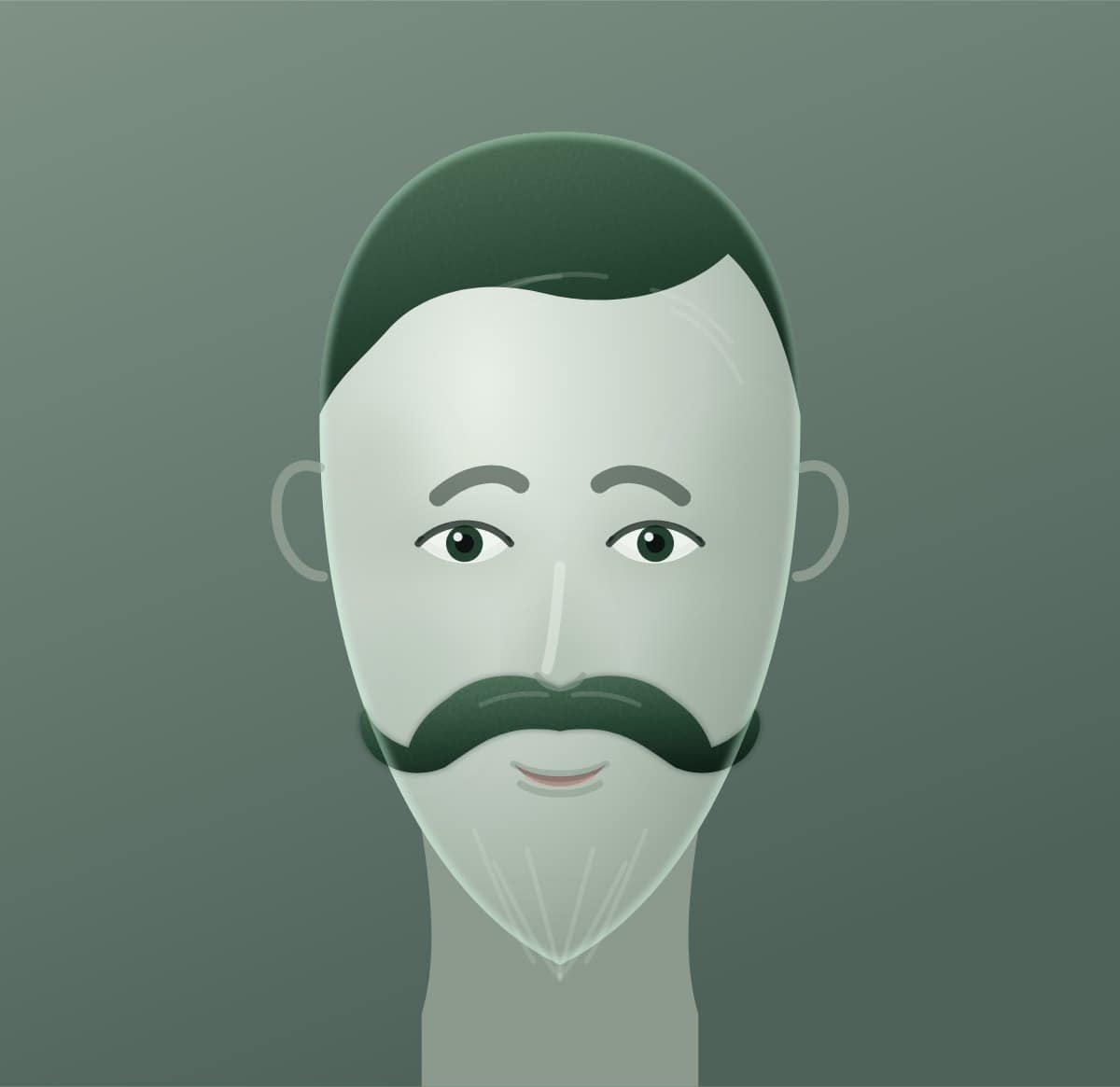
A handlebar moustache is a long moustache with the ends trained upward and outward into a curve. The name comes from the shape, which resembles the handlebars of a bicycle. It is the most demanding facial hair style in this directory, and the only one where the daily routine involves a product rather than a blade.

At a glance
- Also known as
- hungarian moustache
- What it is
- Long moustache trained upward at the ends.
- Length
- Long, three inches and up
- Growing time
- 4 to 6 months or more
- Trim how often
- Every 1 to 2 days
- Best face shapes
- Any
- Moustache
- Yes
£5 off your first delivery
Everything below the lip comes off so the moustache has something to stand against.
Valid on your first order of blades. We send the newsletter rarely, and you can unsubscribe in one click.
The variations
The same shape, worn differently. What changes is length, density and how much you take off at the edges.
Will it suit your face?
Where a style puts weight, and where it takes it away, is what decides whether it suits you. The table below is the short version.
| Ovale | Ideal | No shape to correct, so anything from a pencil to a handlebar sits well. |
|---|---|---|
| Rond | Works | Go wider than the mouth rather than heavier, so it does not add bulk. |
| Carré | Ideal | A strong jaw carries a heavy moustache without looking top-loaded. |
| Oblong | Ideal | Horizontal weight across the lip breaks up the length. |
| Heart | Works | Draws the eye down from a broad forehead. |
| Diamant | Works | Adds width across the middle of the face. |
How to cut one, in four steps
- Grow it out4 to 6 months or more. No trimming at all in that time, including the hairs hanging over your lip.
- Set the shapeComb it down and flat, then cut to your outline. Never cut it wet, it dries shorter than you cut it.
- Clear the lipTrim along the top lip line so it does not end up in your mouth. Scissors give more control than a trimmer here.
- Wax and trainWarm the wax between your fingers first, work it in from the centre out, then shape the ends.
Full detail, tools and the common mistakes are in the guide below.
What counts as a handlebar
The ends have to lift. A thick moustache that hangs over the lip is a walrus, however long it gets. A handlebar moustache is defined by the upward curve at the tips, and that curve comes from length plus training plus wax.
Below that, opinions vary. Some insist a true handlebar leaves the top lip visible and stops there. Others let the moustache cover the lip entirely. Both are worn, and both are called handlebars.
The style needs the cheeks and chin shaved, or at least kept much shorter, so the moustache has something to stand against.
Handlebar moustache styles
Classic handlebar. Full body, ends trained up into a firm curve. What most people picture.
Petite handlebar. Smaller, with a tighter curl at the ends and less bulk through the middle. Faster to grow and it needs less wax, which makes it the sensible starting point.
Hungarian. Bigger and bushier than the classic, with the ends less tightly curled. More facial hair, less sculpture.
Imperial. The ends swept upward more steeply, closer to vertical. Heavier wax and more training.
Handlebar with a full beard. The moustache styled and waxed while the beard is worn full underneath. Common now, and it takes some of the pressure off the moustache to carry the whole face.
Handlebar with a soul patch. A tuft under the lower lip to balance the weight of the moustache above.
What you need before you start
Very little, but the few things matter.
Moustache wax is the one item you cannot do without. Firm hold for a classic handlebar moustache, softer hold if you want a looser curve. Buy a small tin first: it lasts far longer than you expect because the correct amount is tiny.
A small moustache comb for pulling the hair out from the centre before you shape it. A pocket comb is fine.
Small, sharp scissors for the lip line and for individual stray hairs. Not a trimmer, which removes more than you intend on a moustache this size.
A hairdryer, optional but useful. Warm hair takes a shape and holds it once cooled, which is most of the trick with a handlebar look.
Huile à barbe for the skin underneath during the growing months, when the itch arrives.
You do not need a specialist trimmer. Almost everything on a handlebar moustache is done with scissors, fingers and wax.
Who it suits
There is no face shape this facial hair style rules out, which is unusual. What it does is add horizontal width across the middle of the face, so it is particularly good on a long or narrow face and needs more care on a very round one, where a tighter petite handlebar reads better than a wide classic.
The genuine constraints are density and patience. A handlebar moustache style needs a moustache that comes in thick enough to hold a shape, and it needs months in which it looks like nothing in particular.
Straight hair curls less willingly than wavy. It is still perfectly possible, it just leans harder on the wax.
How long it takes to grow
Four to six months for a classic handlebar. Two to three for a petite one.
Facial hair grows at roughly half an inch a month, and you need real length at the corners of the mouth before there is anything to curl. There is no way to shortcut this and no product that speeds it up.
The hard part is the middle. Somewhere around month two the moustache is long enough to get in your mouth and not long enough to train, and that is where most attempts end. Keeping the lip line trimmed through that stage is what makes it survivable.
Do not trim the ends at all while growing. Every millimetre you take off the tips is a week you have added.
The growing timeline, month by month
Weeks one to four. Nothing much happens. Keep the cheeks and chin shaved so the growth reads as intentional rather than as a missed shave.
Weeks four to eight. The awkward stage. The moustache is over the top lip and into your mouth, and it looks untidy from every angle. Trim the lip line, do not touch anything else, and start applying a little wax daily even though there is nothing to curl. You are training direction, not shape.
Months two to four. The corners begin to reach past the mouth. This is when daily combing and waxing starts paying back, because hair that has been pushed outward for two months now lies outward on its own.
Months four to six. Enough length at the ends to curl properly. Now you can start deciding on the desired shape: tighter for a classic handlebar, looser for a Hungarian.
Beyond six months. The moustache reaches whatever length suits your face and you begin maintaining rather than growing. Only now is it reasonable to start trimming the ends, and only to keep the two sides even.
Training and waxing
This is the daily work, and it is a few minutes rather than a chore.
Comb it first. Warm the moustache with water or a hairdryer on low, then comb it out from the centre toward each end. Warm hair takes a shape; cold hair fights it.
Warm the wax. Take a small amount, less than you think, and work it between your fingers until it goes soft and clear. Cold wax drags and leaves lumps.
Work it in from the centre out. Push the wax down into the hair rather than coating the surface, following the direction you want the moustache to lie.
Shape the ends. Twist each side between finger and thumb, then curl upward. Hold for a few seconds while the wax sets.
Do it every day, even early on when there is nothing to curl. Training is cumulative, and hair that has been pushed the same way daily for two months starts holding that direction on its own.
Strong wax for firm curls, softer wax for a looser look. Beard oil on the skin underneath if it gets itchy, but keep oil out of the ends or the wax will not hold.
Trimming without ruining it
Keep the trimming to two places.
The lip line, which needs the hair kept clear of your mouth. Comb the moustache down and trim along the top of the lip with scissors, which give more control than a trimmer.
Stray hairs, individually, with the same scissors. There will be a few that refuse to lie with the rest, and cutting those is different from trimming the moustache.
That is it. The ends stay untouched until the moustache has reached its desired shape and length, which for a classic handlebar is a good six months away.
Living with one
The practical questions come up more than the styling ones.
Eating and drinking take a small adjustment. A handlebar moustache trained upward mostly stays out of the way, which is one of the arguments for the style over a walrus. Hot drinks are the main hazard, since steam softens wax.
Sleeping flattens one side more often than not. Most men simply reshape in the morning, which takes a couple of minutes once the moustache has been trained for a few months.
Reshaping through the day is normal. Carry the tin if you are out, or accept a softer handlebar look by the evening.
Growing it out or shaving it off is the easiest part. If you decide the handlebar moustache is not for you, trimming it back to a chevron or a natural moustache takes one cut, and you keep most of the length for something else.
What goes wrong
The ends get trimmed. The single most common way a handlebar moustache fails. Once cut, you are months from getting it back.
Too much wax. It looks greasy and stiff rather than shaped. Less, warmed properly, works better than more.
Giving up in month two. The awkward stage is real and it passes. Trim the lip line, leave everything else.
Uneven sides. One side almost always curls more willingly. Train the stubborn side slightly more each day rather than cutting the good one down to match.
Oil in the ends. It softens the wax and the curl drops.
Questions we get asked
How long does it take to grow a handlebar moustache?
Four to six months for a classic, two to three for a petite handlebar. Facial hair grows about half an inch a month, and the ends need real length before they will hold a curl.
Do you have to use moustache wax?
For a handlebar, yes. The upward curve is not something hair does on its own. Softer waxes give a looser shape, but some hold is essential.
How do you sleep without flattening it?
The curl usually survives, and if it does not, re-waxing takes two minutes in the morning. Some men use a lighter wax overnight, though most simply reshape.
Can you have a handlebar moustache with a full beard?
Yes, and it is a common combination. The beard carries the lower face while the moustache is styled and waxed on its own.
Why does one side curl better than the other?
Growth direction is rarely symmetrical. Train the stubborn side a little more each day rather than trimming the other to match.
Is a handlebar moustache suitable for work?
A petite handlebar reads as neat in most workplaces. A large classic one is a statement, and whether that suits your work is a question only you can answer.
Other moustaches
Same shape, different length or moustache.
If this one is too much work
Same idea, less of your morning.
Browse by what matters to you
The same directory, cut a different way.