
The Colonel’s Journal / Grooming & Guides
How to Shave Your Chest Without the Itch That Follows
Last updated on
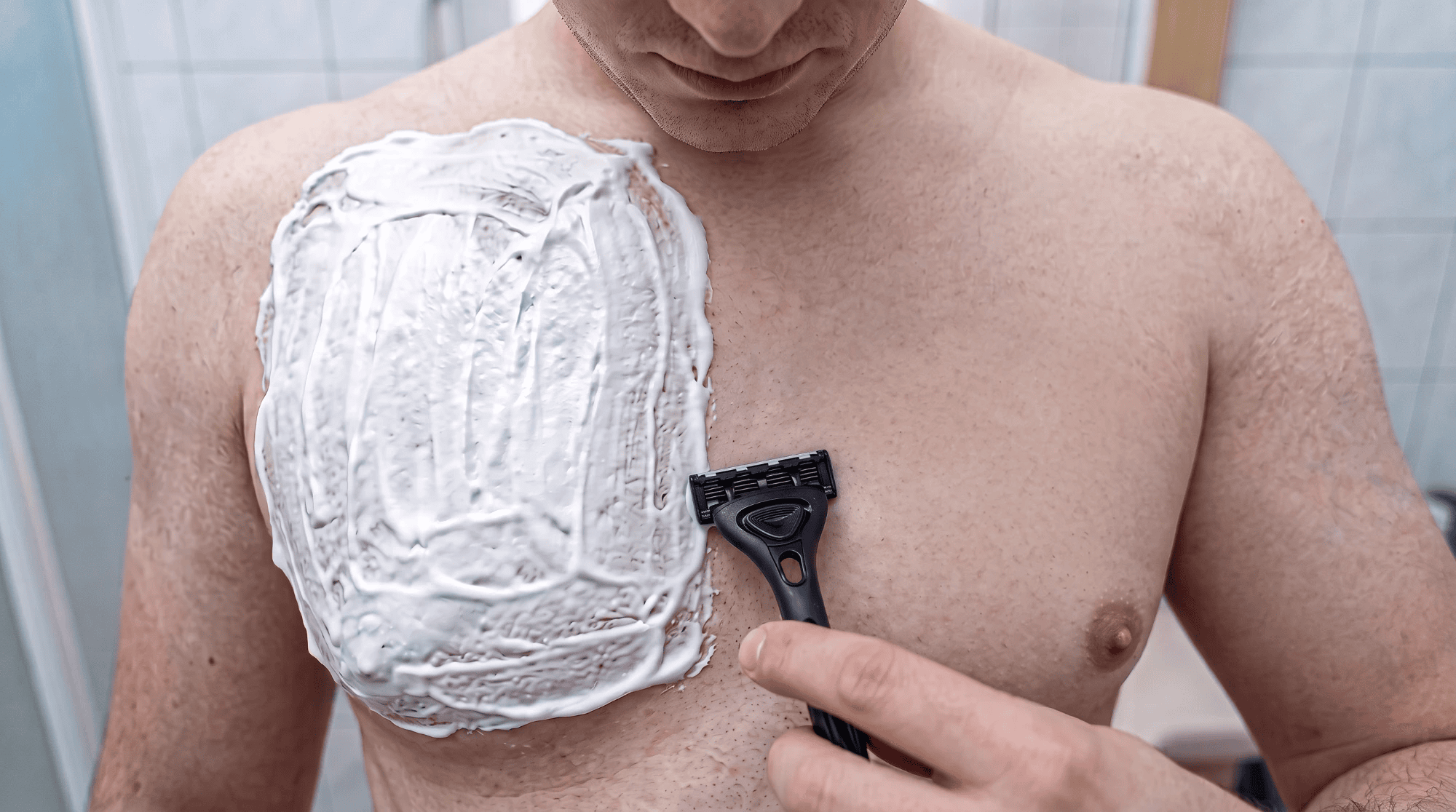
Plenty of men who try it once give up because of the regrowth, not the shave. Three days in, the stubble arrives, it catches on every shirt you own, and you decide the whole thing was a mistake. It usually is not the shave that went wrong. It is what happened before and after it.
Arms and back get a section each at the end, because the answer is different for both.
On this page
Is it even a thing men do
Yes, and more than it used to be, though the numbers are smaller than the internet suggests.
A chest gets through blades faster than a face does, and a blunt one is what causes most of the trouble above. The Bearded Colonel posts four fresh refills through your letterbox as often as you actually shave.
See the plansMintel’s UK research put chest hair removal at 13% of British men in 2014. By 2018 it was 30% among men aged 16 to 24, double the 15% recorded in 2016. Across all body hair, 46% of that age group removed some, up from 36% two years earlier.
The same research also asked about pressure. 19% of men said they felt expected to remove chest hair, and 58% of 16 to 24 year olds felt some pressure to groom body hair, against 22% of the over-65s.
Both figures are getting old now, and neither has been refreshed publicly since. Take them as a direction of travel rather than today’s number.
Our own view is the boring one: it is hair, on your chest, and nobody sensible is scoring you on it. Shave it because you prefer it, not because a 19% figure suggests somebody somewhere expects it.
Trim before you shave, always
Dragging a razor through long chest hair clogs the cartridge within about two strokes. After that you are not shaving, you are pulling. The blade stops cutting cleanly and starts tugging hairs out at the root, which is where the red spots the next morning come from.
Take everything down to short stubble first with clippers on a 3 to 6mm guard. Work in sections: collarbones first, across the pecs, then down to the upper stomach. Go slowly over the nipples and over bony ground like the sternum and the ribs, where the skin does not sit flat and a guard can catch.
Stand in the shower with the water off, or put a towel down. It makes the clean up a ten second job rather than a twenty minute one.
If you stop here, that is a perfectly good result. A tidy 3mm chest looks deliberate, holds for a fortnight, and skips every problem in the rest of this article. Plenty of men trim and never shave, and they are not missing anything.
Prep: warm water, then exfoliate
Shave at the end of a shower, not the start. Five to ten minutes of warm water softens the hair and softens the skin around it, and soft hair cuts instead of bending away from the blade.
Wash the area with a body wash rather than a bar soap, which can leave a film the cream then sits on top of. Then exfoliate: a mitt, a flannel or a mild scrub, small circles, no pressure. This lifts the flat-lying hairs so the blade meets them square, and it clears the dead skin that otherwise traps a hair on its way back out. That trapped hair is an ingrown, and exfoliating is most of the fix.
Rinse properly so no scrub is left behind, and leave the skin damp rather than dry.
The shave itself
Use a sharp blade and enough lubrication. Both matter more than technique.
A blunt blade is one of the main causes of chest irritation, because a blade that has stopped cutting is a blade that is scraping. If the razor drags rather than glides, change it. On a chest you will get through cartridges faster than you do on a face, because there is more ground to cover.
Spread a proper layer of shaving cream across the whole area. Something clear or semi-clear helps, because you can see where you have been. Avoid anything heavily fragranced, and if your skin reacts to shaving anywhere else, it will react here too, so use a sensitive formula.
Then:
- Short strokes, light pressure. Let the blade do the work. Pressing is how you turn a shave into a graze.
- With the grain, first pass. Chest hair rarely grows in one direction. Around the sternum it often grows inward, and over the pecs it fans outward. Check which way it lies before each section rather than assuming.
- Rinse the head often. Every couple of strokes. A loaded cartridge stops cutting.
- Stretch the skin on the curves. Free hand pulling the skin flat, across the chest and near the armpits, where the ground moves under you.
- Only go again if you need to. Reapply cream first. Never dry-pass over skin you have already shaved.
When you are done, check the edges in good light: under the collarbones, along the ribs, and up towards the neck. Those are the bits you miss.
Blend the edges or it looks like a costume
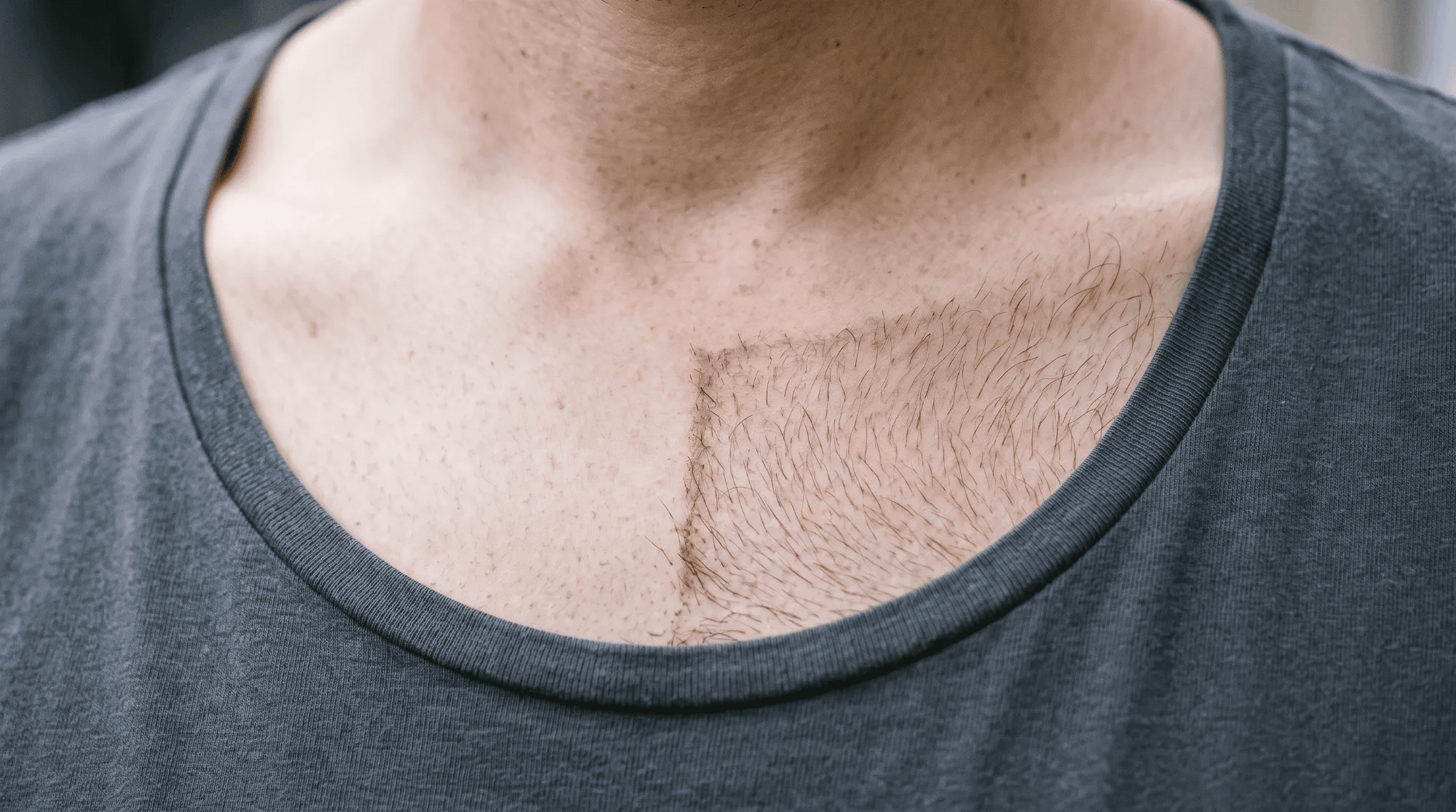
A shaved chest that stops in a hard line at the collarbone or the waist looks odd, particularly with a shirt open.
Take the clippers back out and run a guard length or two over the boundary. Above the chest into the neck, below into the stomach hair. You are aiming for a gradient rather than a border. It takes about a minute and it is the difference between looking groomed and looking like you ran out of time.
Aftercare, which is where the itch is won or lost
Rinse with cool water. Pat dry, do not rub.
Then moisturise, properly, while the skin is still slightly damp. An alcohol-free balm or a fragrance-free lotion with aloe or glycerin in it. Alcohol stings freshly shaved skin and then dries it, which is the opposite of what you want.
Put a clean cotton shirt on. Not a fresh gym top, not a rucksack, not anything that will rub across the area for the rest of the day.
Then keep exfoliating. Two or three times a week, gently, between shaves. This is what decides whether the regrowth itches. Hairs coming back through clear skin lie flat. Hairs coming back through a layer of dead skin curl over and go back in.

How often, honestly
Stubble turns up within two to four days on most men.
If you want a permanently smooth chest, that means shaving every two or three days, and that is a real commitment on skin that is not used to it. If your chest starts objecting, the answer is not a better razor, it is less frequency: drop to a clipper tidy every week or two and let the skin recover.
| Method | Smooth for | Comfort | Ingrown risk |
|---|---|---|---|
| Trim, 3-6mm guard | 1 to 2 weeks | Easy | Low |
| Shave | 2 to 4 days | Fine if prepped | Moderate |
| Wax | 3 to 6 weeks | Painful | Moderate |
| Hair removal cream | Several days | Patch test first | Low to moderate |
A lot of men who think they want a shaved chest would be happier with a trimmed one. It is worth finding that out with a clipper before you find it out with a razor.
Do not use your face razor on your chest
Technically you can. Practically it is a bad habit for two reasons.
The first is hygiene: you are moving bacteria between your body and your face, and the face is the one with the open pores and the aftershave on it.
The second is wear. A chest uses up a cartridge much faster than a jaw does, so whichever one you shave second is getting the worse end of a blade that has already done a day’s work.
Keeping a second handle for body work solves both, and it costs very little because the blades are the same. One handle lives by the sink, the other lives with the body kit or in the wash bag.
A blunt blade is behind most of the problems above. That is the honest argument for a razor subscription: fresh blades turn up on an interval you set, so you stop shaving your chest with a three week old cartridge because you forgot to buy more.
If your skin is the reactive sort, use a sensitive formula here rather than a scented one.
Arms, and why they are easier
Arms are the same job with less to go wrong. Flatter ground, less curve, thinner hair on most men.
Same order: trim first if it is long, warm water, cream, with the grain, short strokes. The one thing to watch is the inside of the upper arm, where the skin is softer and the hair changes direction near the armpit.
Arms are the most visible place to get it wrong. A half-shaved forearm with a hard line at the wrist or the sleeve is more obvious than anything on a chest, so blend both ends.
Backs: you cannot do this properly on your own
Plain answer, because you will find plenty of sites pretending otherwise.
A standard razor is about twelve centimetres long. Your shoulder blades are not within reach of it, and the part you can reach is the part nobody looks at. You can get the tops of your shoulders and a little of the upper back, and that is where it stops.
Three things work: a long-handled body shaver made for the job, an electric back groomer with an extended arm, or somebody else holding the razor. There is no technique that gets around the length of your arm.
If you only want the hair shorter rather than gone, clippers on a long guard are more forgiving, because a missed patch reads as uneven rather than as a stripe.
We do not make a long-handled razor, so we are not going to pretend our handle reaches. It does not.
Legs, while you are here
Legs are the one part of this where the ground is already covered. If you are working down the body, the approach is the same and we have written it up separately in should men shave their legs, including how often, and what the hair does when it comes back.
Questions we get asked
Does chest hair grow back thicker after shaving?
No. Shaving cuts the hair at the surface and does not touch the follicle, so nothing about thickness, colour or rate changes. What changes is the tip: an uncut hair tapers to a point, a cut one ends flat, and flat ends feel coarse. Once the hair is long enough to taper again, it feels exactly as it did.
Why does my chest itch more than my face after shaving?
Chest skin is thinner, it is under a shirt all day, and it is not conditioned to being shaved the way a face is after fifteen years of practice. The itch is usually friction rather than the shave: cotton, no rucksack, and moisturise while the skin is damp.
I get red spots every time. What am I doing wrong?
Usually one of three things: a blade that has done too many shaves, no exfoliation, or shaving against the grain on the first pass. Change the blade first, because it is the cheapest test. If it persists past a fortnight or the spots become painful, see a GP rather than buying more razors, because folliculitis needs treating rather than shaving around.
Can I shave my chest and leave my legs alone?
Yes, and most men do. There is no rule that the hair has to match. If the contrast bothers you, trimming the bits in between is enough to make it look like a decision rather than an oversight.
Trim or shave, if I can only pick one?
Trim. It looks deliberate, it lasts two or three times as long, it causes almost none of the problems above, and you can always go shorter later. Going the other way means waiting a fortnight.
Missed a spot?
More from Grooming & Guides
How to Shave Properly: A Step-by-Step Guide to a Close, Clean Shave
Most shaving problems have nothing to do with the razor. They come from rushing the prep, pressing too hard, or going over the...

What Age Should You Start Shaving? Your First Shave, Start to Finish
There is no set age to start shaving. Most lads start in their early to mid teens, when the hair gets dark enough to notice.
The Perfect Beard Neckline: How to Find It, Trim It and Keep It Clean
Set your beard neckline two finger widths above the Adam's apple, in a soft curve from ear to ear.