
Beard fade
How to Get a Clean Faded Beard at Home
A beard fade is a gradient. The hair runs short at the top, near the sideburn and cheekbone, and gets progressively longer toward the jaw, so there is no hard line where the beard starts. Done well, nobody can point at where it begins.

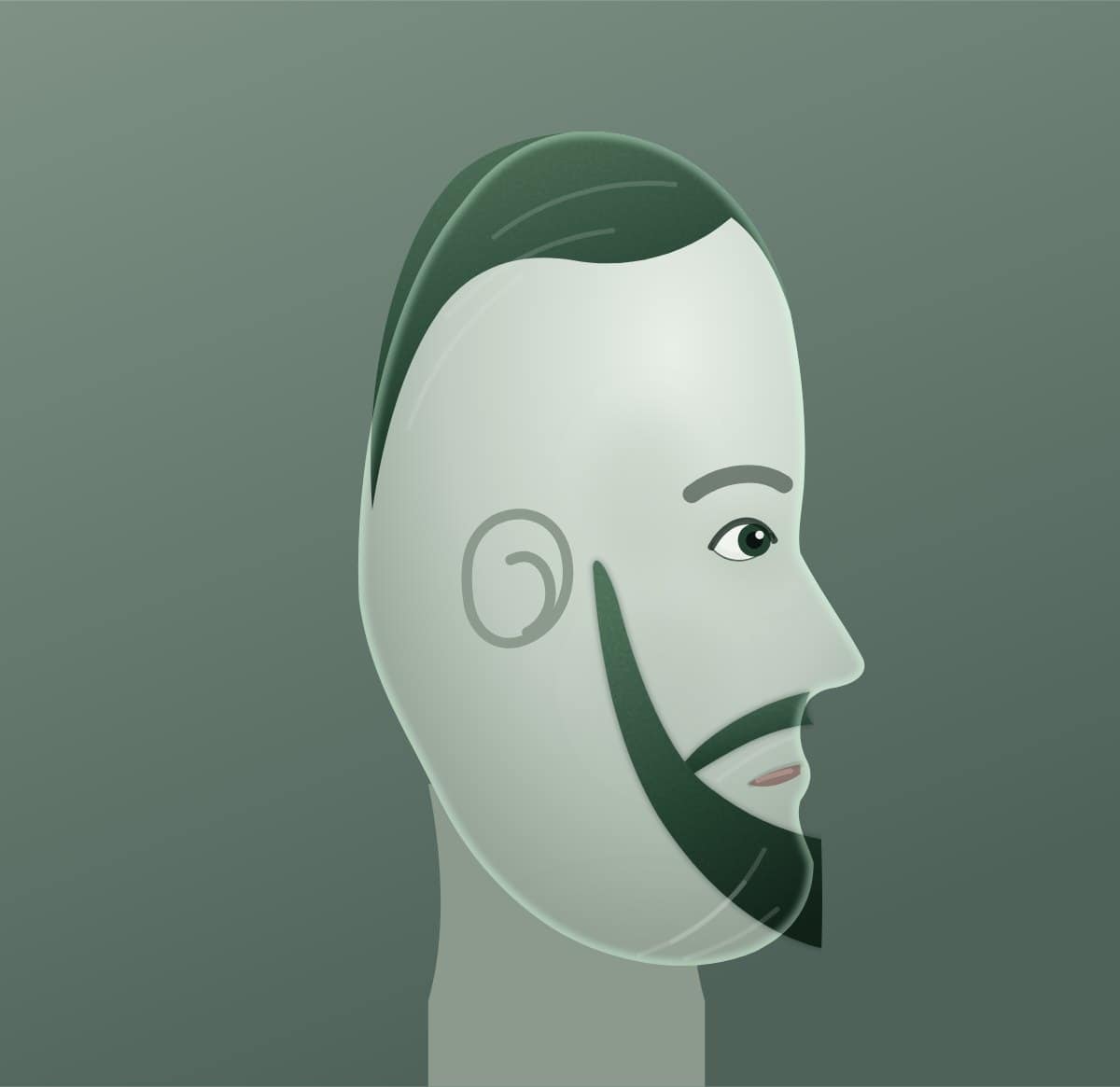
At a glance
- Also known as
- faded beard, beard fade styles
- What it is
- A full beard graded from the cheek down to the jaw.
- Length
- Short, under an inch
- Growing time
- 3 to 4 weeks
- Trim how often
- Every 1 to 2 days
- Best face shapes
- Any
- Moustache
- Yes
£5 off your first delivery
A fade is graded hair meeting bare skin. The bare skin has to actually be bare or the gradient has nothing to end against.
Valid on your first order of blades. We send the newsletter rarely, and you can unsubscribe in one click.
The variations
The same shape, worn differently. What changes is length, density and how much you take off at the edges.
Will it suit your face?
Where a style puts weight, and where it takes it away, is what decides whether it suits you. The table below is the short version.
| Oval | Ideal | Takes almost any length and shape without fighting the proportions. |
|---|---|---|
| Redondo | Avoid | Adds width where there is already width. A chin-led style suits better. |
| Quadrado | Works | Round the corners off or it doubles up on a jaw that is already strong. |
| Oblongo | Ideal | Width at the cheeks shortens the face. Keep the chin short, not pointed. |
| Heart | Works | Weight low balances a wide forehead, so long as the cheeks stay tidy. |
| Diamante | Ideal | Fills the narrow jaw and squares off the lower face. |
How to cut one, in four steps
- Grow it out3 to 4 weeks. Cutting into a beard that has not filled in leaves holes you then have to grow out again.
- Set the lengthStart on a longer guard than you think you need and work down. You cannot put it back.
- Set the necklineTwo fingers above the Adam's apple, curving up to behind the jaw. Higher than that and you lose the jawline.
- Tidy the cheeksFollow your natural cheek line rather than inventing a straight one. Take off anything above it.
Full detail, tools and the common mistakes are in the guide below.
What a faded beard actually is
Every other beard style has an edge somewhere. Faded beard styles replace that edge with a smooth transition, which is why a beard fade suits men who find a hard cheek line too severe.
The fade usually runs from the sideburn down the cheek, blending your haircut into your beard so the two read as one thing. Some men also fade the neckline, though that is less common and harder to judge on yourself.
Three versions get talked about. A low fade starts the transition near the jaw and is the most subtle. A mid fade begins around the cheekbone. A high faded beard starts up near the temple and gives the strongest contrast. There is also the skin fade, taken right down to bare skin at the top, which is the boldest and least forgiving of the lot.
Which faded beard styles suit your face shape
A beard fade works on almost any face shape, because you control where the gradient sits and that placement does the shaping.
On a round face, keep the beard hair longer at the chin and fade higher up the cheek. That narrows the sides and adds length. On a long face do the reverse: a low fade keeps some width across the cheeks, where a high one would strip it away and make the face look longer still.
Face shape aside, the real requirement is facial hair with some density. A fade needs enough to blend through, and patchy cheeks leave gaps in the middle of the gradient where there should be a smooth run. If your cheeks come through thin, a defined edge will look better than a bad fade.
What you need
A beard trimmer with adjustable guards is the whole job. You cannot fade with one fixed trimmer setting, because the gradient is made by stepping down through guard sizes.
You want three or four guards covering your beard length and below. A beard trimmer with half sizes makes blending easier, because the steps between lengths are smaller and the joins are less visible. A detail trimmer or a bare blade handles the top of the fade and the neckline, and a comb lets you lift the facial hair to check the transition underneath.
Beard oil afterwards, once the hair is cut, keeps the longer hair sitting flat so the gradient reads properly.
Fading a beard, step by step
Start with a clean, dry beard combed downward. Wet hair sits longer than it dries, and you will cut too much.
Set the full length first. Trim the whole beard to the length you want at the jaw. Everything else is taken shorter than this, so it is your baseline.
Pick where the fade starts. Somewhere between the top of the sideburn and the cheekbone. Higher gives more contrast.
Step down through the guards. Go one guard shorter than your baseline and cut from your chosen line upward. Then another guard shorter, starting a little higher again. Each pass covers a smaller band than the last.
Blend the steps out. This is what separates a smooth transition from stripes. Use a guard between the two you just used, or the same beard trimmer guard held at an angle, and work over each join with short flicking movements away from the skin.
Check in a different light. Steps that are invisible in the bathroom show up clearly by a window. Comb the beard hair upward as well, which exposes joins that lie flat when combed down.
Set the neckline last. Two fingers above the Adam's apple, curving up toward the ear. On most faded beard styles this is the one line that stays a hard line, and getting the Adam's apple reference right is what stops the beard creeping down the throat.
Keeping it
Every few days, because a fade is only a gradient while all the lengths keep their relationship to each other.
Beard hair does not grow at a uniform rate across the face, so after a week the shortest band catches up and the transition flattens. Re-cutting the top of the beard fade is usually all it needs, and it takes a couple of minutes rather than a full re-do.
Keep the lip line trimmed and the neckline re-cut weekly. Use a little beard oil through the longer hair so it lies flat rather than standing away from the gradient.
What goes wrong
It comes out as stripes. The commonest fault, and it means the blending pass was skipped. Go back over each join with an intermediate guard.
The fade starts too high. Easy to do and slow to fix, because you are waiting on the shortest hair to grow. Start lower than you think and take it up next time.
The sides do not match. Work in the same order on both, and check with the beard combed upward.
The neckline gets forgotten. A beautifully faded beard with a neglected neck still looks unkempt from the side.
Questions we get asked
How long should my beard be before fading it?
Enough length at the jaw to blend down from, so at least half an inch. Below that the guard steps are too close together to make a visible gradient.
Can you fade a beard with one trimmer?
Yes, provided it has several guards. The gradient comes from the guard sizes, not the trimmer, so one adjustable machine is enough.
What is the difference between a low, mid and high fade?
Where the transition starts. Low begins near the jaw and is subtlest, mid around the cheekbone, and a high faded beard up near the temple for the strongest contrast.
Can you fade a patchy beard?
It is difficult. Faded beard styles need continuous facial hair to blend through, and gaps interrupt the gradient. A defined cheek line usually looks better on patchy growth.
Which beard styles work best with a fade?
Anything with real length at the jaw: a full beard, a boxed beard or a ducktail all take a fade well. Short beard styles have less room for the gradient to develop.
How often does a faded beard need re-cutting?
Every few days. The shortest band grows back fastest and flattens the transition first.
Should the neckline be faded too?
Usually not. Most faded beard styles keep a defined neckline and fade only the cheek. Fading the neck is harder to judge on yourself and easier to get wrong.
Other full beards
Same shape, different length or moustache.
If this one is too much work
Same idea, less of your morning.
Browse by what matters to you
The same directory, cut a different way.